Procurement guide
Procuring a medication dispensing service
What Finnish tenders for a medication dispensing service have actually required, what has earned quality points, and what has caused bids to be excluded. Compiled from published procurement decisions and notices from 2021–2026. We name no suppliers and publish no competitor prices. The individual decisions are public and checkable on HILMA: this page collects the recurring patterns, it does not replace reading them.
What do medication dispenser tenders require?
In Finnish medication dispensing service procurements, mandatory requirements have included lockable storage for a dose that was not taken and a fixed, clear display supplied as standard at no extra cost. A mandatory requirement is checked before price and quality are compared, and failing one has caused bids to be excluded. Quality points have been awarded for reporting, for authentication and access management, and for training and onboarding, with scoring turning on how concretely each was described. The price and quality weighting has varied: 50/50, 70/30 and 80/20 have all been used, and one award was made on lowest accepted price alone. Dose sachets and medication cups are often tendered as separate lots of the same procurement.
Mandatory requirements that have excluded bids
A mandatory requirement is checked before price and quality are compared. If it is not met, the bid is excluded and its price never matters.
Lockable storage for an untaken dose
A dose not taken by its deadline must be routed into a locked container the patient cannot reach afterwards. This has been a mandatory requirement, and failing it has caused a bid to be excluded before any comparison.
Ask the bidder: Request a description of the mechanism, how the container is emptied, and how the event is logged.
A fixed, clear display as standard at no extra cost
The display must be part of the standard configuration, not priced as an accessory. This has also been mandatory, and bids have been excluded on it.
Ask the bidder: Confirm the display is included in the monthly price and that accessibility is described.
Where the quality points have been awarded
The quality share has in practice turned on how concretely these three were described. General promises have not scored.
Reporting
Which events the device records, how they are exported and to whom. Reporting has carried quality points.
Authentication and access
Roles, sign-in, multi-factor authentication and a traceable audit log. Assessed as part of quality.
Training and onboarding
How staff are trained, what material is supplied and how competence is maintained as staff turn over.
What to settle before writing the tender
The supplier field is thin: size requirements accordingly
One wellbeing services county’s 2024 procurement (PPHVA/11401/02.03.00.02/2024) drew two bids for the whole thing. Comparison was on 48-month total price and the procurement was divided into lots by dispensing format. With a field that thin, an extra mandatory requirement does not raise quality: it drops you to one bid or none. Every mandatory requirement is worth justifying.
When to listen to the market
Procurements are published on HILMA (hankintailmoitukset.fi), but by then the requirements are already written. Market dialogue happens before the invitation to tender, and it is the only point at which you can still establish what the market can actually deliver: before a requirement rules it out.
Framework agreements and priority order
These have typically been awarded as framework agreements naming several suppliers in a priority order, not a single winner, and the same procurement is often split into separate lots by format. Preparing a single-winner procurement produces the wrong documents.
Two formats, two different procurements
In Finland these procurements split into two formats: dose sachets packed by the pharmacy, and medication cups filled by a nurse. They are often tendered as separate lots of the same procurement. Settle the format before writing requirements, because it narrows the field of bidders.
Video-assisted medication taking
A video connection to support taking medication has become a recurring request and has been piloted as part of expanding remote care. If it is a goal, write it explicitly into the requirements and the scoring.
Integrations and information security
Integration with patient record systems, security requirements and service levels are repeatedly the heaviest technical section of the documents. Ask these openly in market dialogue, not for the first time in the tender.
Price and quality weighting
Across published procurements the weighting has varied widely: a balanced 50/50, a quality-leaning 70/30, and a strongly price-led 80/20 have all been used. In one case the award was made on lowest accepted price alone, with no quality comparison at all.
Choose the weighting for what is actually expected of the service. If the quality share is small and every accepted bidder scores full marks on it, quality does not differentiate the bids at all and the award is decided on price alone.
Where MoniDose stands
- Lockable storage for a dose that was not taken. A dose is not released unless it is taken: the sachet stays uncut on the roll inside the device’s locked enclosure. An expired dose is routed to an internal, per-patient container that only a nurse empties: the patient cannot reach it afterwards.
- Dual-patient mode. One device serves two residents with separate schedules, alerts and logs. On publicly available information we have not found an equivalent among other home dispensers.
- Fixed display as standard. The device has an integrated touchscreen, and the interface adapts across four views depending on the user.
- Two-way video and voice. Video-assisted medication taking is implemented on the device.
- Regulatory status. MoniDose is a Class I medical device (with software) under EU MDR 2017/745. The company and the device are registered with Fimea and in EUDAMED, and the device has its UDI. CE marking is coming soon but has not yet been completed. This should be reflected in the procurement timetable.
This page makes no conformity claim we have not verified. Ask for the detail in market dialogue and we will answer it on the record.
The two-patient medication dispenser
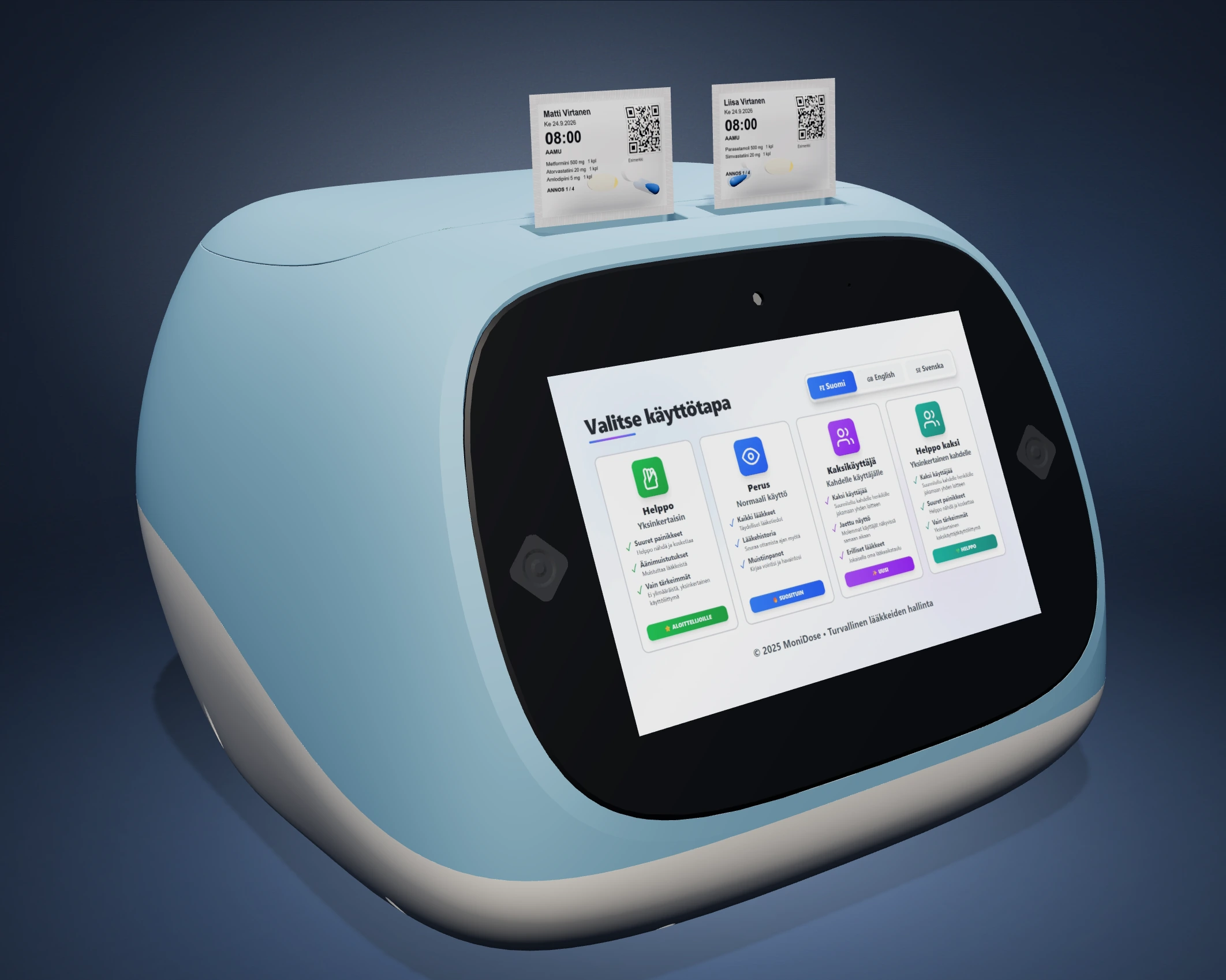
One device, four modes. The mode is chosen at onboarding to suit the resident.
Preparing a medication dispensing tender?
We are glad to take part in market dialogue and answer questions on requirement definition.