From prescription to taken dose: one streamlined chain
One device that adapts to different situations: for an older person living alone at home, for two spouses, for a care home and its staff. This page explains clearly what happens from the moment the doctor writes a prescription to the moment the medicine is taken, and how the family member, nurse and pharmacy receive information about dosing events and alerts.
Five people, one safe chain
From the pharmacy all the way to the doctor: everyone has their own role, and everyone sees the information that matters for their own work. Nothing unnecessary distracts, but everything needed is available.
Pharmacy
Packs the medicines into a ready-made dose sachet roll for two or four weeks at a time, according to the resident’s prescriptions. Sees from its own app how medicines are being used and when the next delivery is needed: without separate phone calls or emails.
Resident / user
Gets their medicine at the right time, in the right dose, without having to remember it themselves. The device gives friendly reminders and speaks Finnish, Swedish or English. The display can be switched to a clear, large-print mode where a single tap is enough.
Family member
Information about whether the medicine was taken goes straight to the family member. They can call their loved one directly through the device: it works even when there is no internet connection at home. Peace of mind, even from another city.
Nurse
On their own phone or tablet, they see at a glance how medication has gone for all residents. Time is freed from routine work back to where a human is truly needed: by the resident’s side.
Doctor / treating party
Sees how the prescribed medication actually works in everyday life. Care records are designed to be stored in a Kanta-compatible format (integration in development), so that information would flow smoothly with existing systems.
Eight steps: from prescription to taken dose
One dose round in practice. The same chain repeats at every dose time, every day, automatically.
The doctor writes a prescription
The prescription recorded in the Kanta system goes to the pharmacy as usual: MoniDose does not change how prescriptions are written in any way.
The pharmacy packs the dose sachet roll
The pharmacy prepares a pre-filled dose sachet roll in 2- or 4-week batches. A single roll can combine several medicines matched to the correct dosing times.
The roll is delivered to the home or care unit
Delivery happens through the pharmacy’s existing dose-dispensing network: the same roll logistics already in use for multi-dose dispensing.
A nurse or family member loads the roll into the device
A simple change once every 2–4 weeks. The device checks with optical sensors that the roll is genuine and in good condition.
Dose time approaches, the device gives a friendly reminder
Shortly before medication time, the device begins to remind calmly: with light, sound and speech in Finnish, Swedish or English. The sound can be muted for the night so sleep is not disturbed.
If needed, verification of the right user
If two people share the same device (for example spouses), the device verifies that the medicine goes to the right person. In single-person use this step is naturally skipped.
The dose sachet becomes available
Storage is locked at all other times: it opens at exactly the right moment. The resident confirms with a single press of a button that the medicine has been taken.
The information flows: everyone sees the same
When the medicine has been taken, the information updates the nurse’s, family member’s and pharmacy’s views. If no confirmation comes, the nurse receives an alert, and for an important medicine, the notification also goes to the family member.
Four views: one truth
Each role has its own app, but everyone looks at the same data as the device reports it, no interpretation differences.
The device view adapts to the resident
The same device, several display options. A clear large-print view for a person with memory illness, a fuller view for someone comfortable with technology, a shared view for two spouses. The mode is chosen together with the resident at the very start and can be changed later as needs change.
Family stays involved, even from afar
A family member can call their loved one directly through the device and exchange messages even when there is no internet connection at home. If a dose is missed, the notification reaches the right person promptly.
The nurse sees the whole picture from their own phone
The nurse has their own app where the situation of all residents is visible at a glance. Alerts are ordered by importance, and there is no need to walk to the device unnecessarily. The connection to the device is made securely with a QR code.
The pharmacy and doctor get a true picture of everyday life
The pharmacy sees how rolls are being used and when the next delivery is needed. The doctor sees how the medication actually works (in development): not just what was prescribed. This helps make better care decisions and anticipate situations.
Four interfaces: one to suit each person
The same device adapts to the resident in two ways: for one resident or two, and a clear view or a full view. The mode is chosen together with the resident at deployment and can be changed later as needs change.
Tap a card to see how the view looks on the device
For a person with memory illness, or someone who has never used a digital device. Large text, one thing at a time and a single tap is enough: the screen shows only what matters right now, and nothing can go wrong.
What is inside the device
The two-patient medication dispenser
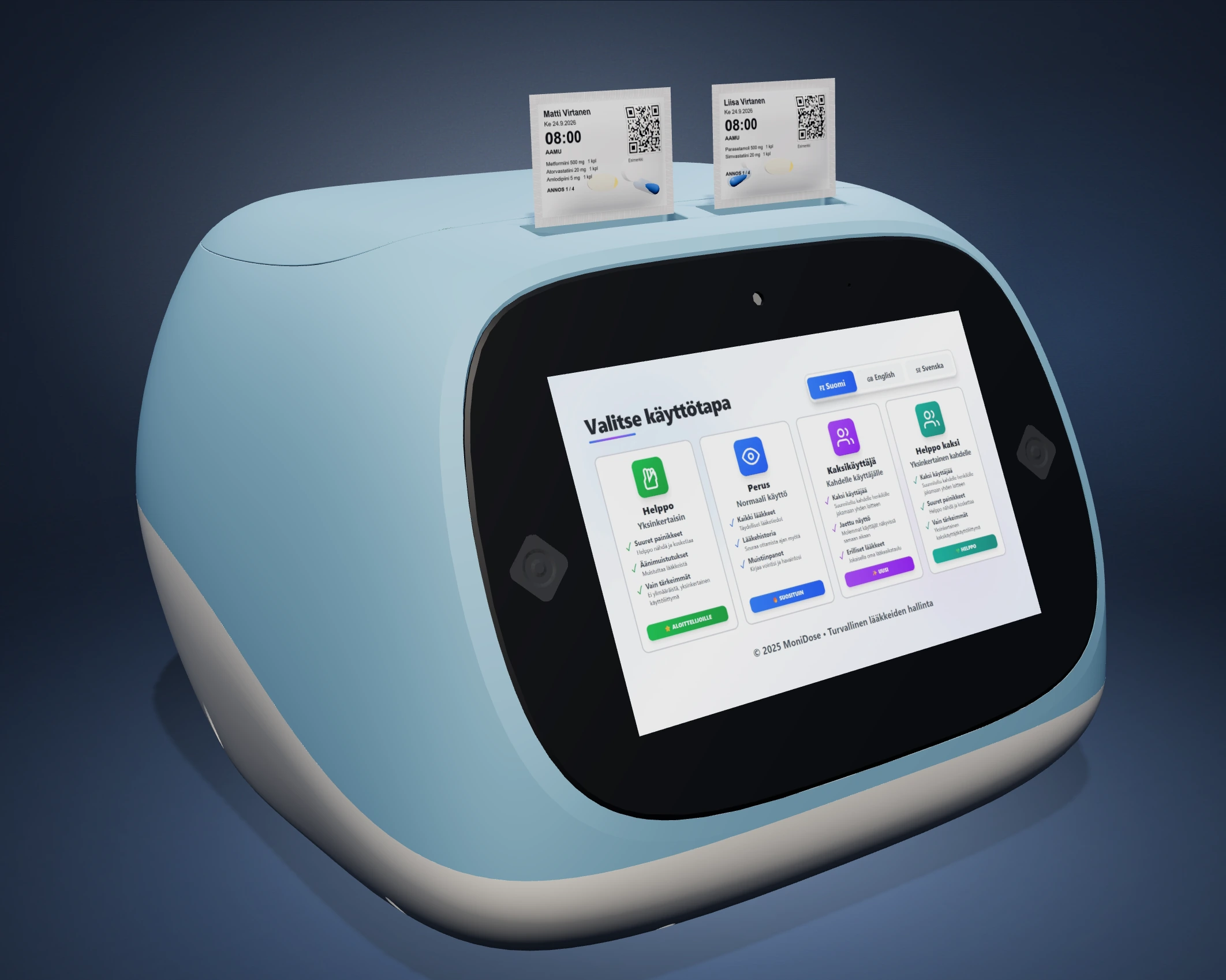
One device, four modes. The mode is chosen at onboarding to suit the resident.
Two roll slots
In single-person use the second roll is always in reserve. In two-person use, each has their own.
Verification of every dose
The device quietly verifies in the background that the sachet is correct and that it was taken.
Secure storage
Medicines are locked away at all other times: available only at the moment they are meant to be taken.
Clear reminders
Sound, light and speech in Finnish, Swedish or English. Can be muted for the night.
Works without a home network
Connectivity and calls run over the cellular network: no home internet needed.
Reliable even in a power cut
If the power goes out, the device keeps working and recovers automatically when power returns.
Medical device
Designed in accordance with EU MDR regulations, as a Class I medical device.
Deployment in four steps
Typical timeline: 2–4 weeks from the first meeting to the first dose.
Introductory meeting
We map the unit’s needs, resident profiles and existing medication. Free of charge.
Installation and configuration
We install the device, connect it to the network and link the pharmacy partner to MoniDose’s pharmacy view.
Staff training
A 2–3 hour training for nurses, family members and the resident. Clear user guides and support materials.
Ongoing support
Remote support, regular health checks for the device, automatic updates.
Designed to fit existing workflows and systems
MoniDose is designed around flexible information flow: the goal is that wellbeing services counties, hospitals, pharmacies and home care providers get the information they need in their own views. System integrations are in development and require national certifications; deployment is always planned around your organization’s ways of working.
Straightforward deployment for wellbeing services counties
MoniDose is designed to work alongside the wellbeing services counties’ own services. Connections to regional systems are planned and require national certifications: they are not yet in use. Deployment can already happen one unit at a time without a region-wide system change, and the nurse app works as its own clear view alongside existing tools.
Omakanta
Designed for prescription transfer via Suomi.fi sign-in (in development, not yet in use), with the goal of eliminating manual entry.
Designed for Kanta compatibility
Care records are designed to be stored in the format required by Finland’s Kanta services (in development, not yet in use), so that information would flow smoothly with your systems.
FIMEA medicinal product data
A connection to Finland’s official medicinal product information: correct names, strengths and label information for all users.
Pharmacy systems
MoniDose works alongside pharmacies’ existing multi-dose dispensing models: no need to switch to another system.
Want to see the device in action?
A free personal demo where we go through your care unit’s situation and answer all your questions.