When Medicine Kills: The Reality of Fatal Medication Errors in Finland
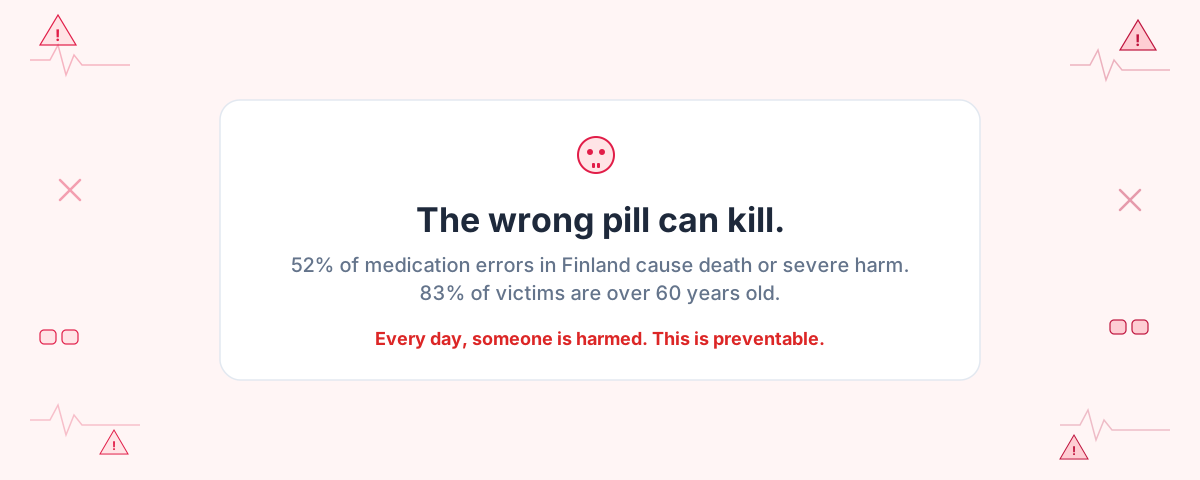
In Finland, 52% of studied medication errors resulted in death or severe harm. 83% of those affected were patients over 60. With 15,000 medication incidents reported through HaiPro every year and a growing elderly population, Finland faces a patient safety emergency that demands systemic solutions — not incremental improvements.
A medication is supposed to heal. When it kills, something has gone profoundly wrong — not with the drug itself, but with the system that delivered it to the wrong patient, at the wrong dose, or at the wrong time.
In Finland, the data on fatal medication errors is not hidden. It is published, studied, and reported. Yet the numbers remain staggering: an analysis of medication error cases handled by Finland's national supervisory authority Valvira found that 52% of studied cases resulted in death or severe patient harm (Frontiers in Pharmacology, 2020). Of those severe cases, 83% involved patients aged 60 or older.
These are not rare events in an otherwise safe system. They are the visible peak of a much larger iceberg of medication harm — one that Finland's HaiPro reporting system documents in growing detail every year.
15,000 Reports, Every Year
Finland's national HaiPro incident reporting system — used by over 200 healthcare organizations — records approximately 15,000 medication safety incident reports annually. This makes medication errors the single most reported category of patient safety incidents in Finnish healthcare.
The trend has been upward. As reporting culture has improved and more units have adopted HaiPro, the volume of reported incidents has grown steadily. Between 2015 and 2023, total medication-related reports increased by over 40%, reflecting both improved reporting and a genuinely expanding problem driven by:
Growing patient volumes — particularly elderly patients with complex medication regimens
Expanding home care — where medication errors are harder to detect and more likely to cause harm before intervention
Increasing polypharmacy — Finland has the highest elderly polypharmacy rate (41%) in the European ADHOC study, with home care patients averaging 9+ medications
Workforce pressure — fewer care workers managing more patients, with less time per medication administration event
It is important to note that HaiPro captures reported incidents — the actual number of medication errors in Finnish healthcare is almost certainly several times higher. International estimates suggest that only 10–20% of medication errors are formally reported (WHO, 2019). If this ratio holds for Finland, the true annual count could exceed 75,000 to 150,000 medication errors.
Where Fatal Errors Begin
Not all medication errors are created equal. Data from Valvira's case analyses, combined with Finnish and international research, reveals a consistent pattern of where in the medication process the most dangerous errors originate:
Prescribing errors (47%) — the most common origin. Wrong drug selection, incorrect dosing, failure to account for drug interactions or patient allergies. In Finland's multi-provider healthcare system, where patients may see multiple physicians and specialists, the risk of prescribing errors is amplified by fragmented medication records
Administration errors (19%) — the medication reaches the patient incorrectly. Wrong dose given, wrong patient receives the drug, wrong route of administration. These errors occur at the point of care and are the last opportunity for prevention
Monitoring failures (17%) — medication is prescribed and administered correctly, but the patient's response is not adequately tracked. Drug levels not checked, adverse reactions not caught, dosage not adjusted as the patient's condition changes
Dispensing errors (14%) — the wrong medication or wrong quantity is prepared and delivered. In manual dispensing environments, look-alike/sound-alike drug names and similar packaging are common contributing factors
The remaining 3% include transcription errors, documentation failures, and communication breakdowns between care providers. While each category has its own risk profile, the critical insight is that errors at every stage of the medication process can be — and have been — fatal.
The Most Vulnerable: Finland's Elderly
The Valvira data is unambiguous: 83% of severe medication error cases involved patients over 60 years of age. This is not a coincidence — it is a consequence of intersecting risk factors that make elderly patients uniquely vulnerable:
Polypharmacy as a risk multiplier: Finland's elderly home care patients have the highest polypharmacy rate in Europe at 41% (ADHOC project). In nursing homes, residents average 9.1 concurrent medications. Every additional drug increases the probability of harmful interactions, dosing errors, and missed doses. A patient on 10 medications has fundamentally different risk than a patient on 2.
Physiological vulnerability: Elderly patients metabolize drugs differently. Reduced kidney and liver function means that a dosing error that might cause minor symptoms in a younger patient can be life-threatening for an 80-year-old. The therapeutic window — the margin between an effective dose and a harmful one — narrows with age for many critical medications.
Cognitive decline and self-management: In home care, many elderly patients are expected to manage some or all of their own medications. For patients with mild cognitive impairment, dementia, impaired vision, or limited dexterity, this is a setup for error. Forgetting doses, doubling doses, confusing medications — these are not failures of patient responsibility but failures of a system that places unreasonable demands on vulnerable individuals.
Care transitions: When elderly patients move between home, hospital, emergency department, and back, their medication lists frequently change. The Danish study finding of 2 medication errors per patient transfer applies across the Nordics. For an elderly Finnish patient with multiple chronic conditions, a single hospitalization may result in several medication changes that are incompletely communicated to home care providers.
Real Consequences, Preventable Causes
Behind the statistics are real patients and real failures. While individual cases are confidential, the patterns documented in Finnish and Nordic research describe scenarios that are tragically common:
Wrong dose of anticoagulant: A patient on warfarin — a blood-thinning medication with an extremely narrow therapeutic window — receives double the prescribed dose due to a transcription error. The result: uncontrolled bleeding, emergency hospitalization, and in severe cases, death. Anticoagulants are consistently among the top 3 drug classes involved in fatal medication errors in Finland and internationally.
Missed diabetes medication: An elderly patient's insulin is not administered on time because of a scheduling mix-up in home care. The patient's blood sugar rises to dangerous levels, leading to diabetic ketoacidosis — a potentially fatal condition. Insulin-related errors account for a disproportionate share of serious medication incidents in Finnish HaiPro reports.
Confused medications between patients: In a care facility with dozens of residents, each on multiple medications, a dose prepared for one patient is administered to another. In Swedish malpractice data, the contributing factor in 68% of medication error cases was "negligence, forgetfulness or lack of attentiveness" — not malice or incompetence, but the inevitable result of humans performing repetitive, high-volume tasks under time pressure. An additional 36% cited "role overload" as a system factor (BMC Health Services Research, 2016).
These are not isolated incidents. They are systemic outcomes of a medication management process that relies on manual handling at every step — from counting pills to preparing dose trays to matching the right medication to the right patient at the right time, dozens or hundreds of times per shift.
What the Evidence Says About Prevention
The research is clear: automated medication dispensing systems dramatically reduce the errors that cause harm and death. The evidence spans multiple countries, care settings, and study designs:
53–80% reduction in medication errors when automated dispensing replaces manual processes. Hospital automated dispensing cabinets reduced dispensing errors from 5% to 1% in multiple studies (Swiss Hospital Study; Taiwan ADC implementation)
53% reduction in administration errors in a French geriatric unit when automated unit-dose dispensing replaced traditional ward stock systems (Journal of Evaluation in Clinical Practice, 2014)
Zero dispensing errors per 100,000 dispensations achieved in an ICU after implementing automated dispensing cabinets, down from 3.87 per 100,000 (NCBI, 2023)
58% overall reduction in medication errors with full traceability systems — electronic prescription, automated preparation, barcode-verified administration (ECAMET White Paper, 2022)
Administration errors cut from 24.3% to 9.7% in a French pediatric hospital after switching to automated unit-dose dispensing
Finland's own data supports the trend. Fimea reports that automated dose dispensing through community pharmacies has grown steadily, reaching 49,500 patients by 2016 and continuing to expand. The growth reflects both demand from an aging population and recognition that manual processes cannot scale safely.
The technology exists. The evidence exists. What is needed is the commitment to deploy automated dispensing as standard infrastructure — not as an optional upgrade, but as the minimum standard of care for medication safety.
Finland can and must lead on this. The data demands it:
Mandate automated dispensing in all care facilities serving elderly patients with polypharmacy — the population where 83% of severe errors occur
Integrate automated dispensing with e-prescriptions and HaiPro to create a closed-loop system where every dose is traceable from prescription to patient
Extend automated solutions to home care, where medication errors are least visible and most dangerous
Set a national target: reduce severe medication harm by 50% within 5 years, aligned with the WHO's Medication Without Harm initiative
Invest in prevention, not just reporting — HaiPro tells us what went wrong, but technology can prevent it from happening in the first place
Every one of the 15,000 medication incidents reported annually in Finland represents a patient who was harmed or could have been harmed by a failure that technology can prevent. The cost of inaction is measured not in euros, but in lives.
Sources: Frontiers in Pharmacology 2020 (Finnish Valvira medication error analysis); HaiPro national incident reporting system data; Fimea (Finnish Medicines Agency) annual reports and automated dispensing statistics; Valvira (National Supervisory Authority for Welfare and Health); WHO Patient Safety Fact Sheet 2019; WHO Medication Without Harm Initiative 2017; ECAMET White Paper 2022; BMC Health Services Research 2016 (Swedish malpractice cases); ADHOC Project (European home care polypharmacy); BMC Medicine 2020 (preventable harm meta-analysis); Journal of Evaluation in Clinical Practice 2014 (French geriatric unit); NCBI 2023 (ICU automated dispensing); BMC Primary Care 2024 (Finnish community pharmacy dispensing errors).