Finland's polypharmacy crisis: 145,000 elderly on 10+ medications
Finland has one of the highest polypharmacy rates in Europe. Nearly half of those over 65 take five or more medications daily, with severe consequences for patient safety and healthcare costs.
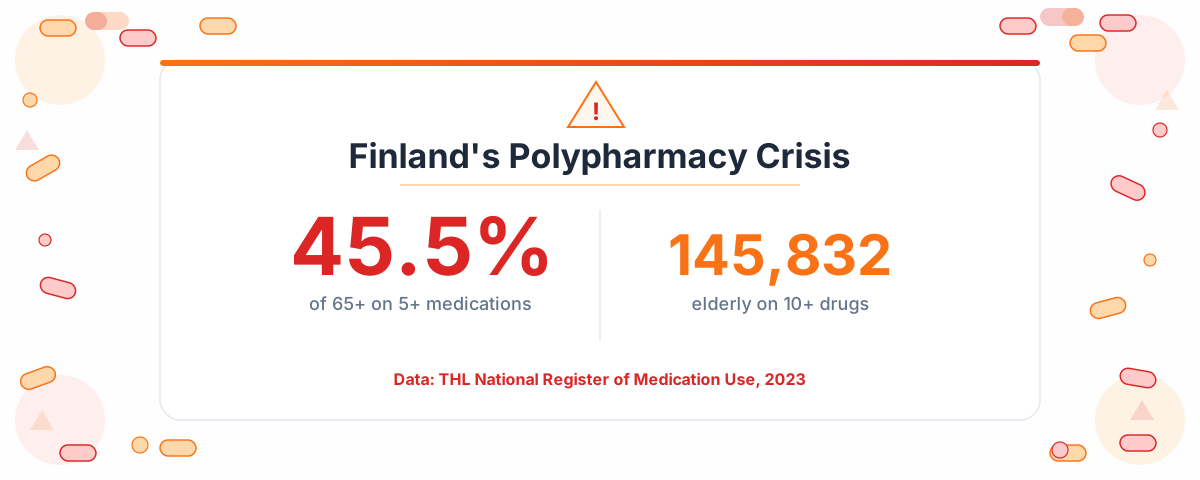
In Finland, 45.5% of adults aged 65 and older take five or more medications daily — well above the European average of 36.2%. Among those aged 75 and older, the situation is far more acute: 145,832 Finns in this age group are on ten or more medications simultaneously, representing 21% of the entire 75+ population. That number grows every year. What was once a clinical edge case — hyper-polypharmacy — has become the norm in Finnish elderly care, with consequences that ripple through patient safety, hospital admissions, and public healthcare spending.
This report examines the latest data on polypharmacy in Finland and the Nordics, its measurable impact on health outcomes and costs, and the evidence for what can be done about it.
The scale of Finland's polypharmacy problem
Finland's polypharmacy rates are among the highest in Europe. Data from the SHARE Wave 9 study (Survey of Health, Ageing and Retirement in Europe) shows that 45.5% of Finns aged 65+ use five or more medications concurrently, compared to the EU average of 36.2% (PMC11856818). Finland consistently ranks at or near the top of European polypharmacy tables.
The Finnish Medicines Agency Fimea tracks medication use through its national indicators. The most recent data reveals that 145,832 Finns aged 75 and older are taking ten or more medications — a threshold known as hyper-polypharmacy — and this figure has been increasing year over year. This is not a fringe population; it represents a full 21% of all Finns over 75.
The growth trajectory is driven by multiple factors: an aging population, the cumulative layering of prescriptions from multiple specialists, the reluctance to deprescribe medications in elderly patients, and the increasing prevalence of multimorbidity. Each new diagnosis tends to add medications without a corresponding review of the existing regimen.
Health consequences: a multiplied risk
Polypharmacy is not merely a matter of medication count — it is a direct multiplier of clinical risk. A 2024 study published in Frontiers in Pharmacology (fphar.2024.1382990) quantified the impact with striking clarity:
Hyper-polypharmacy (10+ medications) is associated with an odds ratio of 2.57 for death — meaning patients on ten or more drugs are more than 2.5 times as likely to die compared to those without polypharmacy
The same patients face an odds ratio of 1.85 for hospitalization, nearly doubling their risk of emergency hospital admission
These associations persist after adjustment for age, comorbidities, and other confounding factors
The risk extends beyond internal medicine. Falls are one of the most devastating consequences of polypharmacy in the elderly. Research shows that 33% of community-dwelling elderly people fall at least once per year (PMC4125318). Specific drug classes dramatically increase this risk:
Antidepressants carry an odds ratio of 1.68 for falls — a 68% increased risk
Benzodiazepines carry an odds ratio of 1.57 for falls — a 57% increased risk
In a population where a single hip fracture can trigger a cascade of immobility, institutional care, and decline, these are not abstract numbers. They represent thousands of preventable injuries and deaths every year in Finland alone.
The cost burden
Polypharmacy is not only a patient safety issue — it is an economic crisis. A systematic review published in BMC Geriatrics (PMC9313779) found that polypharmacy is associated with:
Approximately 2x total healthcare expenditure compared to patients without polypharmacy
Approximately 3x pharmacy expenditure — the direct cost of the medications themselves
In Finland, the financial scale is substantial. According to Social Insurance Institution of Finland (Kela) data, the average annual prescription cost per person aged 75 and older reached EUR 1,127 in 2023. This figure has grown by 18.1% between 2020 and 2023 — an increase that outpaces general healthcare inflation and reflects both the growing number of prescriptions per patient and rising drug prices.
For a population of 145,832 Finns aged 75+ on ten or more medications, the direct pharmacy costs alone are enormous. But the indirect costs — emergency department visits, hospitalizations from adverse drug events, falls, extended care needs — multiply the economic burden many times over. When polypharmacy doubles total healthcare spending per patient, the aggregate national cost impact runs into hundreds of millions of euros annually.
Finnish home care: ground zero
If there is a single setting where the polypharmacy crisis is most acute, it is Finnish home care. The FIMA study (Finnish Investigation of Medication use Among home care patients), published in Clinical Interventions in Aging (PMC6763522), examined the medication burden of elderly home care patients and produced alarming findings:
87% of Finnish home care patients have excessive polypharmacy — defined as ten or more medicines
The mean number of medicines per home care patient is 15 — far beyond any threshold where safe self-management is realistic
74% of these patients have clinically relevant drug-drug interactions in their medication regimen
These are not patients in hospital wards with continuous monitoring and pharmacy oversight. These are elderly people living at home, often alone, managing extraordinarily complex medication regimens with limited support. A patient taking 15 different medications may need to manage multiple dosing times, varying instructions (with food, without food, two hours apart from another drug), and changing prescriptions — all while potentially dealing with cognitive decline, vision impairment, or reduced manual dexterity.
The 74% rate of clinically relevant drug-drug interactions is particularly concerning. These are not theoretical risks flagged by conservative software algorithms — these are interactions identified as clinically significant by pharmacological review. In a home setting without real-time clinical oversight, these interactions go unmonitored until they produce symptoms, an emergency visit, or worse.
When errors become fatal
The consequences of polypharmacy-driven medication errors in Finland are not hypothetical. Data analyzed by Valvira (Finland's National Supervisory Authority for Welfare and Health) and published in Frontiers in Pharmacology (PMC8612921) examined reported medication safety incidents and found:
Medication errors caused death or severe harm in 52% of reported cases
83% of these severe cases involved patients over 60 years old
This is the population most affected by polypharmacy — and most vulnerable to its consequences. When a patient on 15 medications receives the wrong dose, misses a critical drug, or experiences an undetected interaction, the margin for error is essentially zero. The complexity of their regimen means that any single point of failure can cascade into a life-threatening event.
The 52% figure for death or severe harm deserves emphasis: this is not a rate of minor inconveniences or near-misses. More than half of reported medication incidents resulted in the most serious possible outcomes. Combined with the fact that medication incident reporting captures only a fraction of actual errors, the true toll is almost certainly higher.
Technology as a solution
The evidence base for technology-assisted medication management in Finland is growing. Two Finnish studies are particularly relevant:
The Finnish ADD study (Automated Dose Dispensing), published in BMC Geriatrics (PMC5730037), examined what happens when automated dose dispensing is combined with structured medication review. The study found that drug use decreased after the introduction of automated dispensing with medication review — in other words, the combination of technology and clinical oversight led to deprescribing and optimization, not just better adherence to an existing regimen. This is a critical finding: the technology itself becomes a catalyst for reducing inappropriate polypharmacy.
The Evondos study, published in BMC Health Services Research (PMC10693699), examined the impact of automated medication dispensing robots in Finnish home care and produced dramatic results:
Home visits decreased by 89.4% at one month after implementation — the vast majority of medication-related visits were eliminated
Working time per patient dropped from 54.2 minutes to 34.9 minutes at two months — a 36% reduction in care worker time burden
These findings directly address the twin crises of polypharmacy management: patient safety and workforce capacity. When a dispensing robot ensures correct medications are available at the correct time, the need for a nurse to physically visit for medication administration drops dramatically. The freed-up time can be redirected to clinical assessment, medication review, and the kind of cognitive care work that actually improves outcomes.
The WHO's Third Global Patient Safety Challenge — "Medication Without Harm" — has set the goal of achieving a 50% reduction in severe preventable drug-related harm. Finland, with its high polypharmacy rates and advanced digital health infrastructure, is well-positioned to lead this effort — but only with the systematic adoption of technology that addresses the root causes of medication errors.
What MoniDose means for polypharmacy patients
The data in this report paints a clear picture of the challenge: too many medications, too many interactions, too many errors, and not enough hands to manage it all safely. MoniDose is designed to address each of these failure points in the medication chain:
Dose accuracy in complex regimens: For a patient on 15 medications with multiple dosing times, MoniDose's automated dispensing eliminates the manual sorting, splitting, and timing errors that lead to wrong-dose and omitted-dose incidents — the two most common error types in elderly care
Drug interaction safety: By being designed to integrate with e-prescription systems and maintaining an accurate view of each patient's medication regimen, MoniDose provides the data infrastructure that supports pharmacist medication review — relevant to the 74% interaction rate found in Finnish home care
Fall prevention: By ensuring time-sensitive medications like antidepressants and benzodiazepines are dispensed correctly and on schedule, automated dispensing reduces the pharmacological risk factors for falls that affect one in three elderly people annually
Home care workforce relief: The Evondos data shows that automated dispensing can reduce medication-related home visits by up to 89%. MoniDose extends this principle with its compact, patient-friendly design — freeing care workers to focus on clinical assessment and human connection rather than pill sorting
Cost reduction: When polypharmacy doubles total healthcare expenditure and triples pharmacy costs, any intervention that supports safe deprescribing and prevents adverse drug events produces immediate economic returns. The EUR 1,127 average annual pharmacy cost per elderly patient is the baseline — the real savings come from preventing the hospitalizations, emergency visits, and extended care episodes that polypharmacy drives
Medication review enablement: Like the Finnish ADD study demonstrated, automated dispensing combined with structured review leads to medication optimization. MoniDose's data logging and adherence tracking give clinicians the evidence base to make informed deprescribing decisions — turning technology into a tool for reducing, not just managing, polypharmacy
The polypharmacy crisis in Finnish elderly care is not a problem that can be solved by awareness alone. It requires infrastructure — reliable, automated, data-driven systems that make safe medication management possible in the settings where patients actually live. That is what MoniDose is built to deliver.
Sources:
*SHARE Wave 9: Polypharmacy prevalence in Europe (PMC11856818)*
*Fimea National Indicators: Medication use among Finns aged 75+ (fimea.fi)*
*FIMA Study: Medication use in Finnish home care (PMC6763522)*
*Frontiers in Pharmacology: Hyper-polypharmacy mortality and hospitalization risk (fphar.2024.1382990)*
*BMC Geriatrics: Polypharmacy and healthcare expenditure (PMC9313779)*
*Kela Data: Prescription costs for elderly patients 2020–2023 (fimea.fi)*
*Frontiers in Pharmacology: Finnish medication safety incidents and Valvira data (PMC8612921)*
*BMC Geriatrics: Falls and psychotropic medications in the elderly (PMC4125318)*
*BMC Geriatrics: Finnish ADD study on automated dose dispensing (PMC5730037)*
*BMC Health Services Research: Evondos automated dispensing outcomes (PMC10693699)*
*WHO: Medication Without Harm — Third Global Patient Safety Challenge (who.int)*