Pharmacy to Patient: The Last Mile Nobody Monitors
Finnish pharmacies prepare automated dose pouches for over 49,500 patients — yet the moment those pouches leave the pharmacy, visibility drops to zero. The pharmacy has 100% control over preparation but 0% confirmation of patient intake. This report examines the last mile problem: the gap between dispensing and adherence that nobody is monitoring.
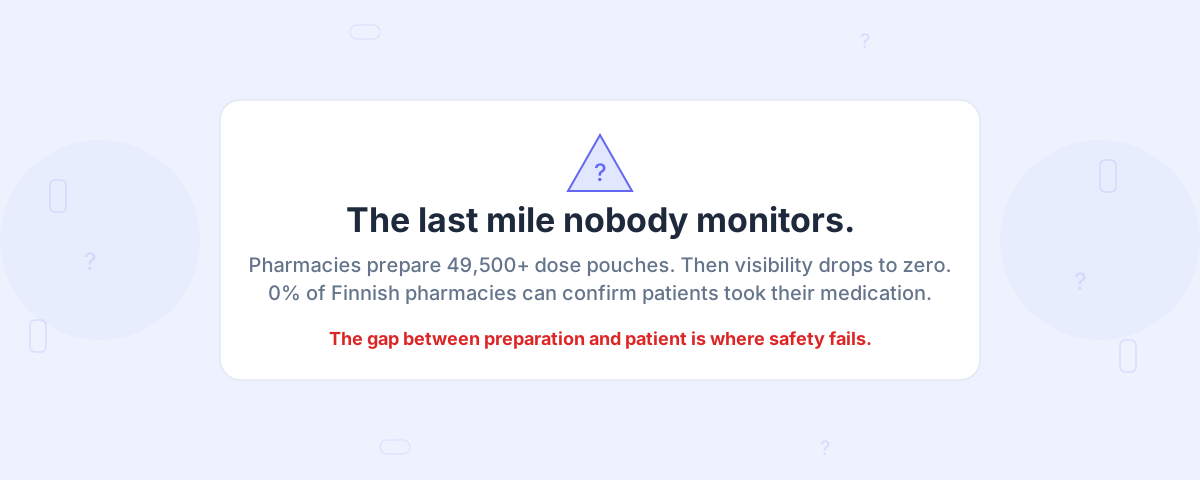
Finnish pharmacies prepare automated dose pouches for more than 49,500 patients (Fimea, 2016 — a figure that has grown steadily since). The process inside the pharmacy is precise, regulated, and well-documented. Every dose pouch is machine-prepared, pharmacist-verified, and logged in the pharmacy system. But the moment that pouch leaves the pharmacy counter, something extraordinary happens: visibility drops to zero.
The pharmacy has 100% control over preparation. It has 0% confirmation of actual patient intake. The pouch enters a black hole — shipped to a home care unit, handed to a family member, or delivered to a patient's doorstep — and from that point forward, nobody in the healthcare chain can confirm whether the medication was taken, taken correctly, or taken at all.
This is the last mile problem. And it is the single largest unmonitored gap in Finland's otherwise excellent medication safety chain.
The Visibility Cliff
Follow the journey of a dose pouch from pharmacy to patient:
Step 1: Pharmacy preparation — Full visibility. The automated dispensing machine records every medication, every dose, every pouch. The pharmacist verifies. Everything is logged.
Step 2: Handoff to logistics — Visibility drops. The pouch is packaged and shipped. The pharmacy knows it left. It does not know when it arrives.
Step 3: Arrival at care unit or home — Partial visibility, maybe. If a nurse receives it, there may be a record. If it's delivered to a patient's home directly, there is none.
Step 4: Storage — Unknown. Is the pouch stored correctly? Is it in the right place? Has the patient's medication changed since these pouches were prepared two weeks ago? Nobody knows.
Step 5: The moment of intake — Complete darkness. Did the patient take the dose? Did they take it at the right time? Did they take yesterday's dose or today's? Did they take it at all? No system records this. No confirmation flows back to anyone.
At every step, information is lost. By the time the patient should take the medication, not a single stakeholder in the system — not the pharmacy, not the doctor, not the nurse, not the family — can confirm what actually happened.
What Happens in the Dark
Without confirmation of intake, problems don't just go unnoticed — they compound silently.
Prescription changes arrive too late. A doctor discontinues a medication on Monday. The pharmacy receives the update on Wednesday. But the patient already has two weeks of pre-prepared dose pouches containing the discontinued drug. They continue taking it for days — sometimes weeks — after it should have stopped. A study in BMC Primary Care (2024) found that discrepancies between prescribed and dispensed medications are alarmingly common in dose dispensing systems, precisely because there is no real-time feedback loop.
Discontinued medications continue to be taken. The inverse problem is equally dangerous. A new medication is prescribed, but the current cycle of dose pouches doesn't include it. The patient misses critical doses of a newly prescribed drug while diligently taking pouches that no longer reflect their actual prescription.
Patients stockpile unused pouches. When patients skip doses — intentionally or accidentally — the unused pouches accumulate. This creates medication waste, confusion about what has and hasn't been taken, and in some cases, dangerous situations where patients take multiple accumulated doses at once to "catch up."
Side effects go unreported. A patient experiences nausea from a new medication and stops taking their evening dose pouch. Nobody knows. The next pharmacy delivery arrives on schedule. The cycle continues.
The Hidden Workload on Pharmacy Staff
The absence of a feedback loop doesn't mean pharmacies ignore the problem — it means they compensate for it manually, at enormous cost.
Pharmacists and pharmacy technicians spend significant portions of their workday on tasks that exist only because there is no automated confirmation system:
Phone calls to care units. "Did Mrs. Virtanen receive her pouches? Has she been taking them? Any issues?" These calls happen daily across thousands of patient relationships. Each call takes 5-10 minutes. Multiply by dozens of patients and the hours add up fast.
Coordination with home care nurses. When a prescription changes, the pharmacy must manually coordinate with nursing staff to ensure old pouches are removed and new ones are introduced. This coordination happens by phone, by fax, sometimes by handwritten notes attached to pouch deliveries.
Managing returns and waste. When patients die, move to institutional care, or have prescription changes, unused dose pouches must be returned and destroyed. Tracking which pouches are outstanding, which need to be recalled, and which have been properly disposed of is a manual, paper-heavy process.
Reconciliation after incidents. When a medication error is discovered — a patient hospitalized, an adverse reaction reported — the pharmacy must reconstruct what happened. Without intake confirmation data, this reconstruction relies on patient memory, family accounts, and guesswork.
None of this is clinical work. None of it requires a pharmacist's expertise in drug interactions, dosing, or patient counseling. It is administrative labor created entirely by a broken information chain. The Finnish Pharmacists' Association has repeatedly highlighted the need for pharmacists to spend more time on clinical services — yet the current system traps them in logistics.
What Pharmacies Actually Need
Pharmacies do not need more forms. They do not need another portal to check. They do not need longer phone trees or more complex return procedures.
What pharmacies need is simple in concept and transformative in practice:
Real-time confirmation that doses were taken. Not a report filed three days later. Not a nurse's note written at end of shift. Actual, timestamped confirmation that a specific dose pouch was opened and the medication was taken by the right patient at the right time.
Automatic alerts when something changes. When a prescription is modified, every stakeholder should know immediately — including the system managing the patient's current dose pouches. No 48-hour delay. No manual phone chain.
A closed loop from preparation to patient to pharmacy. The pharmacy prepares the pouch. The pouch reaches the patient. The patient takes the dose. Confirmation flows back to the pharmacy, the nurse, the doctor, the family. The loop closes. Problems are caught in hours, not weeks.
Visibility into adherence patterns. Not just "was this dose taken?" but "what does this patient's medication behavior look like over time?" Patterns reveal problems: a patient who consistently misses evening doses, a patient whose adherence drops every weekend when family isn't visiting, a patient who takes doses erratically.
The Nordic Pharmacy Opportunity
Finland's pharmacy system is uniquely positioned to solve this problem — because the hardest part is already done.
Automated dose dispensing already serves over 49,500 patients. The machine infrastructure exists. The pharmacy workflows are established. Pharmacists are trained. Patients are enrolled. The regulatory framework under Fimea is mature. Nordic pharmacy systems — Finland, Sweden, Denmark, Norway — share similar structures, similar challenges, and similar readiness.
The missing piece is not the beginning of the chain. The beginning works. The missing piece is the end — the last mile. Confirmation. Visibility. A closed feedback loop that connects the point of dispensing to the point of intake and back again.
The pharmacy that can see what happens after the pouch leaves the counter is a pharmacy that can:
Reduce waste by knowing exactly which pouches are being used
Catch errors faster by detecting missed doses in real-time
Free pharmacist time by replacing manual follow-up with automated confirmation
Improve patient outcomes by enabling early intervention when adherence drops
Support prescribers with actual adherence data instead of assumptions
The infrastructure is built. The patients are enrolled. The last mile is the last problem. And it is solvable.
Sources: Fimea — Finnish Medicines Agency dose dispensing statistics; BMC Primary Care 2024 — medication discrepancies in automated dose dispensing; Finnish Pharmacists' Association — pharmacist workload and clinical service capacity; Nordic pharmacy workflow studies — cross-border analysis of dose dispensing systems in Finland, Sweden, Denmark, and Norway.