Built with nurses, not just for them: why co-design changes everything
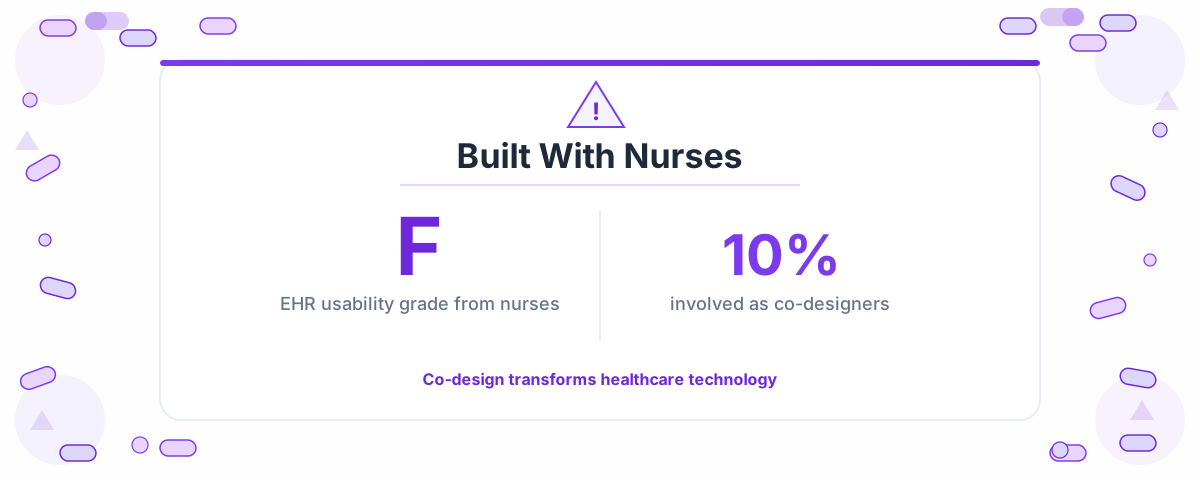
Nurses rate healthcare technology an F. Only 10% are involved as co-designers. MoniDose took a radically different approach — continuous co-design with nurses and patients builds the product from the ground up.
Healthcare technology is failing the people who use it most. Nurses — the largest clinical workforce in any health system — interact with health information technology more frequently and more intensely than any other professional group. Yet the systems they depend on were overwhelmingly designed without their input. The result is technology that slows them down, burns them out, and in too many cases, puts patients at risk. The World Health Organization estimates that medication errors alone cost $42 billion per year globally, with 1 in 30 patients harmed during care. Much of this harm traces back to tools that were built for nurses but never built with them.
MoniDose was designed on a fundamentally different premise: that the people who use a system every day must shape it from the first prototype to the final product. Through continuous biweekly iteration cycles with nurses and regular patient sessions, every screen, every interaction, and every workflow is tested, challenged, and refined by the people whose hands actually operate it. This report examines why that approach is not just preferable but necessary — and what happens when the industry gets it wrong.
The F-grade problem
Nurses give healthcare technology a failing score — and the data leaves no room for debate. A landmark study published in the Journal of the American Medical Informatics Association found that nurses rate electronic health record (EHR) usability at just 57.6 out of 100 on the System Usability Scale. That score corresponds to a letter grade of F (Melnick et al., JAMIA 2021, PMC8324227).
To put this in perspective, the System Usability Scale is the most widely used standardized usability questionnaire in the world. A score of 68 is considered average. Scores below 51 are rated as unacceptable. At 57.6, the technology nurses rely on every day sits in the bottom quartile of usability — worse than most consumer software, worse than most enterprise tools, and far worse than the safety-critical systems in aviation, nuclear energy, or automotive manufacturing that healthcare technology is often compared to.
The consequences of this failing grade are not abstract. The same research found that 42% of nurses meet established criteria for professional burnout. And the relationship between usability and burnout is direct and measurable: each 1-point improvement in System Usability Scale score was associated with 2% lower odds of burnout among nurses. A separate analysis confirmed the mechanism — poor EHR usability was linked to 41% higher odds of burnout (OR 1.41) and 61% higher odds of job dissatisfaction (OR 1.61) among nurses (Kutney-Lee et al., PMC8187272).
This is not a minor ergonomic complaint. This is a workforce crisis driven by technology that was never designed with its primary users in mind.
Consider what poor usability looks like in practice. Research has documented that in one hospital, nurses required 23 separate screens to chart a single morning patient assessment (Dykes & Chu, PMC7753642, citing Kossman 2008). Twenty-three screens. For one assessment. For one patient. Multiply that across a ward of 15 or 20 patients, across three or four assessment rounds per shift, and the scale of wasted time and cognitive burden becomes staggering.
The F-grade is not because nurses are resistant to technology. It is because the technology was built without understanding how nursing work actually happens.
When technology hurts instead of helps
The usability crisis is not merely an inconvenience — it is a patient safety emergency. A systematic review published in the Journal of the American Medical Informatics Association examined the relationship between health information technology (HIT) problems and patient outcomes. The findings are alarming: 53% of the studies reviewed found that HIT-related problems were associated with patient harm, including death (Kim et al., JAMIA, PMC7651955).
The mechanisms are well documented:
Alert fatigue — when systems generate hundreds of low-relevance warnings per shift, nurses learn to click through them, missing the critical alerts buried in the noise
Workarounds — when systems are too slow or too rigid, clinicians develop unofficial shortcuts that bypass built-in safety checks
Data entry errors — when interfaces require excessive clicks, redundant entries, and navigation through dozens of screens, transcription errors multiply
Cognitive overload — when technology adds complexity rather than reducing it, the mental burden on already-stretched nurses increases error probability across all tasks
Delayed care — when documentation takes longer than the care itself, patients wait longer for medications, assessments, and interventions
The industry-wide failure rate tells the broader story: analyses consistently estimate that up to 70% of healthcare IT projects fail to meet their objectives. These are not failures of ambition or investment. They are failures of process — specifically, the failure to involve end users meaningfully in design.
The WHO's $42 billion annual cost of medication errors is not just a function of human fallibility. It is a function of systems that make errors easy and correct practice hard. When 23 screens stand between a nurse and a completed assessment, when usability scores an F, when more than half of HIT studies link technology problems to patient harm — the problem is not the nurse. The problem is the design process that excluded nurses.
The co-design gap
If the evidence for user involvement is so overwhelming, why are nurses still excluded from the design process? A 2025 review by Kobekyaa and colleagues examined the state of nurse participation in health information technology development. The finding is stark: only 10% of nurses act as co-designers in HIT development projects.
The remaining 90% are, at best, consulted after key design decisions have been made. More often, they are simply handed a finished product and told to adapt. The review also found a clear signal in the other direction: when nurses did participate as co-designers, the resulting systems were perceived as more acceptable, more effective, and more usable by their end users.
This finding aligns with broader evidence from participatory design research. A systematic review published in the Journal of Medical Internet Research (2020) analyzed the outcomes of participatory design approaches in healthcare technology and found that participatory design outputs were effective across 50 studies — a consistent pattern of improved outcomes when users are genuine partners in the design process, not afterthoughts.
The gap between evidence and practice is a structural problem. Most health IT development follows a traditional model:
Phase 1: Engineers and product managers define requirements based on clinical literature, regulatory standards, and business objectives
Phase 2: Designers create interfaces based on those requirements, often informed by general UX principles rather than domain-specific observation
Phase 3: A prototype is shown to a small number of clinical "champions" for feedback
Phase 4: The product is deployed, and real-world problems are addressed through patches and updates
Phase 5: Nurses adapt — or develop workarounds — or burn out
The critical missing element is sustained, iterative, ground-level co-design with the people who will use the system daily, under real conditions, with real patients, under real time pressure. Brief feedback sessions with clinical champions are not co-design. Surveys after deployment are not co-design. Co-design means nurses are in the room — repeatedly, over months and years — shaping decisions before they become locked in.
MoniDose's approach: continuous iteration, zero assumptions
MoniDose was built on the conviction that a medication dispensing system cannot be safe, usable, or effective unless it is shaped by the hands that will operate it. This was not a philosophical position — it was a design methodology embedded in every stage of development.
The process reflects the commitment:
Continuous biweekly iteration cycles with nurses — not one-off feedback sessions, but sustained, structured co-design spanning the entire development lifecycle. Every two weeks, nurses working in real care environments test current prototypes, identify friction points, propose improvements, and validate changes from the previous cycle
Regular patient sessions — because the end user is not just the nurse but also the patient. Elderly patients, patients with cognitive impairment, patients with limited dexterity, patients who have never interacted with a digital device — all test the system under real conditions, and their experience shapes every interface decision
What does this look like in practice?
Early iterations revealed that nurses needed the system to require zero training for basic operation. Not minimal training. Not intuitive training. Zero. Because in understaffed facilities with high turnover, any system that requires training before use creates a barrier that delays adoption and introduces error risk during the learning period. This requirement — which no engineering team would have generated from a specification document — fundamentally shaped the product architecture.
Mid-stage iterations uncovered that the physical interaction model mattered as much as the digital interface. How the device sits on a medication cart, how dose packets are loaded and retrieved, how the system communicates status through sound and light — these details were refined through dozens of cycles of nurse observation and feedback.
Late-stage iterations focused on edge cases that only emerge in real clinical environments: what happens when a patient refuses medication, when a dose is dropped, when a shift handover occurs mid-round, when the network connection is intermittent, when a new temporary staff member encounters the system for the first time. Each scenario was tested, refined, and tested again.
The EU Medical Device Regulation (MDR) requires usability engineering in accordance with IEC 62366-1:2015 for all medical devices with software. MoniDose's co-design process is designed to go beyond the baseline this standard requires: where the standard calls for usability evaluation, MoniDose aims to embed usability co-creation into the development lifecycle itself.
The results: what co-design produces
The outcomes of this approach are measurable and specific:
Usability as a design priority — MoniDose is designed to deliver the kind of simplicity and clarity that existing EHR systems famously lack (nurses rate those at just 57.6 in published studies). Our design goal is a product that doesn't just meet the usability bar — it raises it
Designed to be simple enough that nurses don't need training — in a field where technology frustration is the norm, where workarounds are standard practice, and where 42% of nurses are burned out, simplicity is the single most important product requirement. Every co-design session is judged against one question: is it easier than last time?
2.5–3.5 hours saved per nurse per day (projected) — our component-based savings model projects that medication preparation, verification, documentation, and error-correction time can be dramatically reduced through MoniDose. For a single nurse, that would be 2.5–3.5 hours per shift redirected from mechanical tasks to patient care. For a facility with 20 nurses, that would be 50–70 hours per day. For a national care system, the numbers would be transformative
These design targets are not accidental. They are the direct, traceable consequence of continuous co-design with nurses and patients. Every design choice, every simplification, every removed step can be linked to a specific co-design decision made by a specific nurse or patient during a specific session.
The contrast with the industry baseline is instructive:
Industry EHR usability: 57.6/100 (grade F) vs. MoniDose: simplicity as a core design priority
Industry nurse co-design involvement: 10% vs. MoniDose: nurses as continuous co-designers throughout development
Industry healthcare IT failure rate: up to 70% vs. MoniDose: being built through iteration rather than guesswork
Industry approach: build, then ask vs. MoniDose approach: ask, build, test, repeat — for years
Why this matters for the future of healthcare technology
The evidence presented in this report points to a conclusion that should reshape how every healthcare technology company operates: co-design with nurses is not a nice-to-have. It is a prerequisite for building systems that are safe, usable, and effective.
The current model is failing by every measure. Usability scores an F. Burnout affects 42% of nurses, with poor technology as a documented driver. More than half of HIT studies link technology problems to patient harm. Up to 70% of healthcare IT projects fail. And only 10% of nurses are involved as co-designers — the single intervention most consistently associated with better outcomes.
MoniDose's approach demonstrates what becomes possible when the model changes:
Patient safety is built in from day one — because the system is being designed around real clinical workflows, not theoretical ones
Nurse burnout can decrease — because usability is co-created with nurses, not imposed on them
Efficiency gains become realistic — because the workflows are tested in co-design sessions before deployment
Regulatory compliance is embedded — because EU MDR usability engineering requirements (IEC 62366-1) are integrated into the process
The technology is built to actually work — because the people who will use it are shaping it
The path forward for healthcare technology is not more features, more data, or more automation for its own sake. It is more listening. More iteration. More humility about what engineers and product managers do not know about clinical work. And more nurses in the room — not as consultants, not as testers, but as co-designers with the authority to shape the tools they will use every day.
Healthcare technology built for nurses without nurses will continue to score an F. Healthcare technology built with nurses — genuinely, iteratively, over years — is the approach MoniDose has chosen, because it is the only approach we believe can produce something rare: technology that clinicians trust, patients can use, and that actually delivers on its promise.
Sources: Melnick et al., "Physician and Nurse EHR Usability and Burnout," JAMIA 2021 (PMC8324227) — nurse EHR usability 57.6/100, 42% burnout, 1-point SUS = 2% lower burnout odds; Kutney-Lee et al., "Electronic Health Record Usability and Nurse Burnout," PMC8187272 — poor usability linked to 41% higher burnout odds (OR 1.41), 61% higher job dissatisfaction (OR 1.61); Kim et al., "Problems with Health Information Technology and Their Effects on Patient Safety," JAMIA (PMC7651955) — 53% of studies found HIT problems linked to patient harm/death; Dykes & Chu, "Poorly Designed EHR Workflows," PMC7753642, citing Kossman 2008 — 23 screens for one morning assessment; Kobekyaa et al., 2025 — only 10% of nurses act as co-designers; when nurses participated, systems perceived as more acceptable, effective, and usable; JMIR 2020 systematic review — participatory design outputs effective in 50 studies; WHO — medication errors cost $42 billion/year, 1 in 30 patients harmed; EU MDR usability engineering requirement per IEC 62366-1:2015; MoniDose internal data — continuous biweekly nurse iterations, regular patient sessions, component-based savings model projecting 2.5–3.5 hours saved per nurse per day; industry analyses — up to 70% of healthcare IT projects fail.