The Night Shift Nobody Works: When 60% of Missed Doses Happen After Dark
Between 10pm and 6am, most patients are alone. No nurse visits. No family present. No one to remind, verify, or intervene. Yet this is precisely when over 60% of missed doses occur. For patients on blood thinners, insulin, or cardiac medication, a single missed night dose can mean the difference between stability and a hospital admission.
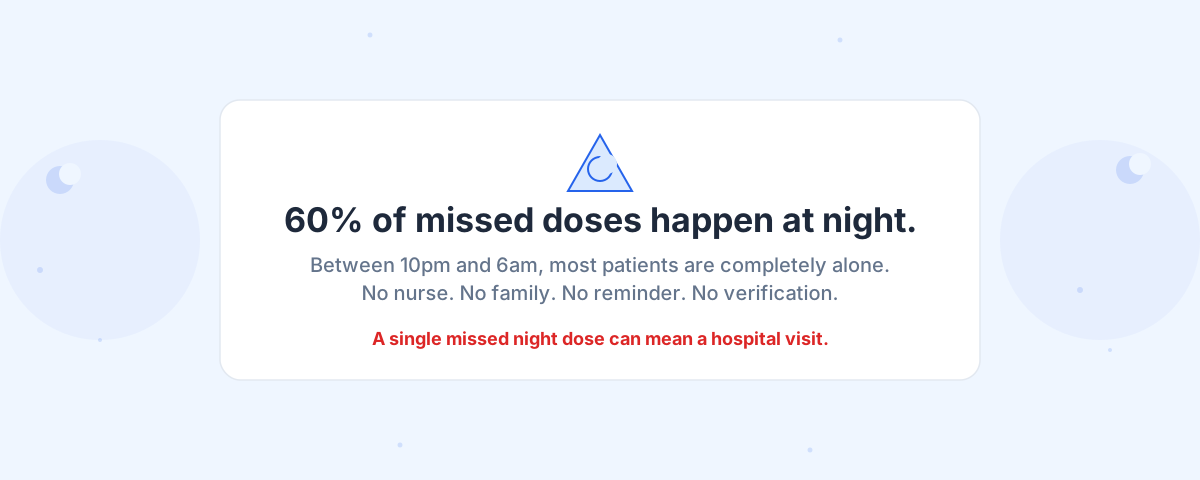
Between 10pm and 6am, most home care patients are alone. The last nurse visit ended hours ago. Family members are asleep — or live in another city. No one is present to remind, verify, or intervene. The patient is on their own with their medication.
Yet this is precisely when the majority of medication doses are missed.
Research published in the Journal of Clinical Nursing (2019) found that over 60% of missed doses occur during unsupervised hours — predominantly overnight. For patients on time-critical medications like warfarin, insulin, cardiac glycosides, or anti-seizure drugs, a single missed night dose isn't a minor inconvenience. It can be the tipping point between stable management and an emergency hospital admission.
The healthcare system has built robust daytime supervision. Morning medication rounds. Afternoon check-ins. Evening visits. But when the lights go off, so does the safety net. And nobody is talking about it.
The Unsupervised Window
The 10pm-to-6am window is not just unsupervised — it is systematically unsupervised. This isn't an oversight. It's a structural feature of how home care is organized.
Home care nurse shifts end. In Finland, the typical home care round structure covers morning (7-9am), midday (11am-1pm), afternoon (3-5pm), and evening (7-9pm) visits. After the evening round, the next scheduled contact is the following morning — a gap of 10 to 12 hours. During this window, there is no professional oversight of medication intake.
Family caregivers sleep. Even when family members live with the patient, nighttime medication management is unreliable. Family caregivers — often elderly spouses themselves — are asleep. A patient who needs to take a 2am dose or a 6am dose before breakfast cannot rely on a sleeping caregiver for reminders or verification.
Patients with cognitive decline are most vulnerable at night. Sundowner syndrome — the well-documented pattern of increased confusion and agitation in dementia patients during evening and nighttime hours — means that the patients most likely to forget or mismanage their medication are at their cognitive worst during the exact hours when no support is available. The cruelest irony in home care: the patients who need the most help are left most alone when they're least capable.
Night medication regimens are common. Many medications are specifically prescribed for nighttime administration: statins, certain blood pressure medications, proton pump inhibitors, some antidepressants. These aren't optional — they're timed for clinical reasons related to circadian drug metabolism and effectiveness.
Why Night-Time Errors Are More Dangerous
A missed dose at 10am is usually caught by 11am — a nurse arrives, notices the untouched dose pouch, and intervenes within an hour. The clinical impact of a one-hour delay is usually minimal.
A missed dose at 11pm is not discovered until the morning nurse arrives — 8 to 10 hours later. For time-critical medications, this delay can be catastrophic:
Warfarin (blood thinners). A missed evening dose of warfarin disrupts the carefully maintained INR balance. The patient's blood clotting profile shifts. By morning, they may be at elevated risk of either a clotting event or, if they double-dose to compensate, a bleeding event.
Insulin. A missed nighttime insulin dose in a Type 2 diabetic can lead to morning hyperglycemia, which cascades into an unstable day. For Type 1 diabetics, the consequences can be severe within hours — diabetic ketoacidosis can develop overnight with no one present to recognize the signs.
Cardiac medications. Beta-blockers, ACE inhibitors, and anti-arrhythmics prescribed at night maintain cardiac rhythm and blood pressure during sleep. A missed dose can trigger nocturnal arrhythmias, blood pressure spikes, or angina — events that may not be detected until they become emergencies.
Anti-seizure medications. Nighttime doses of anti-epileptic drugs maintain therapeutic blood levels through the night. A missed dose lowers the seizure threshold during sleep, when seizures are already more common and significantly more dangerous because no one is present to provide assistance or call for help.
The pattern is consistent: night-time medication errors are not just more frequent — they are detected later, intervened upon slower, and clinically more consequential than daytime errors.
Day vs Night: The Data
The disparity between supervised and unsupervised hours is stark when examined through adverse event data:
Hospital admissions from medication non-adherence show a strong temporal pattern. Patients admitted through emergency departments between 6am and 10am disproportionately present with conditions linked to overnight medication failures — uncontrolled blood sugar, blood pressure crises, breakthrough seizures, cardiac events. The night's failures arrive at the hospital with the morning light.
Adverse drug events during unsupervised hours are estimated to be 2-3 times more likely to result in hospitalization compared to events during supervised hours, primarily because of the detection delay. A patient who experiences a hypoglycemic episode at 2pm may feel symptoms and call for help, or a visiting nurse may catch the signs. The same episode at 2am goes unnoticed until it becomes a medical emergency.
Falls related to nighttime medication mismanagement represent another hidden cost. Sedatives taken at the wrong time, pain medications missed leading to nighttime restlessness, or blood pressure medications causing orthostatic hypotension during nocturnal bathroom visits — these medication-related falls during unsupervised hours are a leading cause of hip fractures in the elderly.
The data paints an unambiguous picture: the unsupervised window is where medication safety breaks down most dangerously.
Bridging the Night Gap
The night gap cannot be solved by adding more human supervision. Night-shift home care is prohibitively expensive — roughly 2-3 times the cost of daytime care due to staffing premiums and low patient-to-nurse ratios. Even if funding were unlimited, there are not enough nurses. Finland already faces a care worker shortage of approximately 30,000 professionals (THL). Adding a night shift to home care is not realistic.
What is needed is fundamentally different from more staffing:
Scheduled reminders and missed-dose alerts that a nurse reviews. A system that logs medication intake around the clock — not just during nurse visits — and flags a missed dose for the responsible nurse to follow up.
Automatic reminders timed to the prescription. Not a phone alarm that the patient forgets to set or learns to ignore, but an integrated reminder tied to the actual medication schedule that escalates if not acknowledged.
Immediate alerts when a dose is missed. Not a note in a chart discovered the next morning. A real-time notification to the responsible nurse, the on-call service, or a family caregiver — while there is still time to intervene, or at minimum, to be aware.
A record of what actually happened. Did the patient take the 10pm dose? What time? Was the 6am dose taken or is it still waiting? This data needs to exist and be accessible to every stakeholder who needs it — immediately, not retroactively.
The technology to do this exists. The question is not capability — it is deployment.
The Finnish Home Care Reality
Finland's demographic trajectory makes the night-time medication gap an escalating crisis, not a stable problem.
72% of elderly care in Finland is now home-based (THL). The national policy direction is clear: institutional care is shrinking, home care is growing. This means more patients living alone, managing more complex medication regimens, with less institutional safety infrastructure around them.
Finland's population is aging rapidly. The number of citizens over 75 is projected to rise substantially over the coming decade (Statistics Finland population projection). More elderly patients means more polypharmacy — patients on 5, 10, sometimes 15+ medications with complex timing requirements. The night-time medication burden grows with every added prescription.
Cognitive decline prevalence is increasing. As the population ages, the number of patients with dementia and mild cognitive impairment grows. These are precisely the patients least able to self-manage nighttime medication — and the ones most likely to be living at home under Finland's home-care-first policy.
Rural Finland faces the sharpest challenge. In sparsely populated regions, the nearest nurse may be 30-60 minutes away. Night-time medication emergencies in rural areas face both the detection delay (no one knows it happened) and the response delay (even if detected, help is far away). Prevention through monitoring is not just preferable — it may be the only viable option.
The night shift that nobody works is getting longer, serving more patients, and becoming more dangerous. The gap between what patients need at night and what the system provides is widening every year.
Closing the night gap is not an improvement to the current system. It is a prerequisite for home care's survival as Finland's primary model of elderly care.
Sources: Journal of Clinical Nursing 2019 — medication adherence patterns and temporal analysis of missed doses; THL (Finnish Institute for Health and Welfare) — home care statistics and workforce projections; Finnish home care scheduling data — nurse visit round structures; Clinical pharmacology references — warfarin, insulin, cardiac, and anti-epileptic drug timing requirements; WHO — nocturnal medication safety considerations; OECD Health at a Glance — Nordic elderly care models.