The Hidden Cost: $42 Billion in Medication Waste Every Year
The world discards $42 billion worth of medications annually. In the EU alone, medication waste costs €21.8 billion per year. Finland contributes over €100 million to that figure. This report examines the systemic roots of pharmaceutical waste across the Nordics and the evidence that unit-dose dispensing can dramatically reduce it.
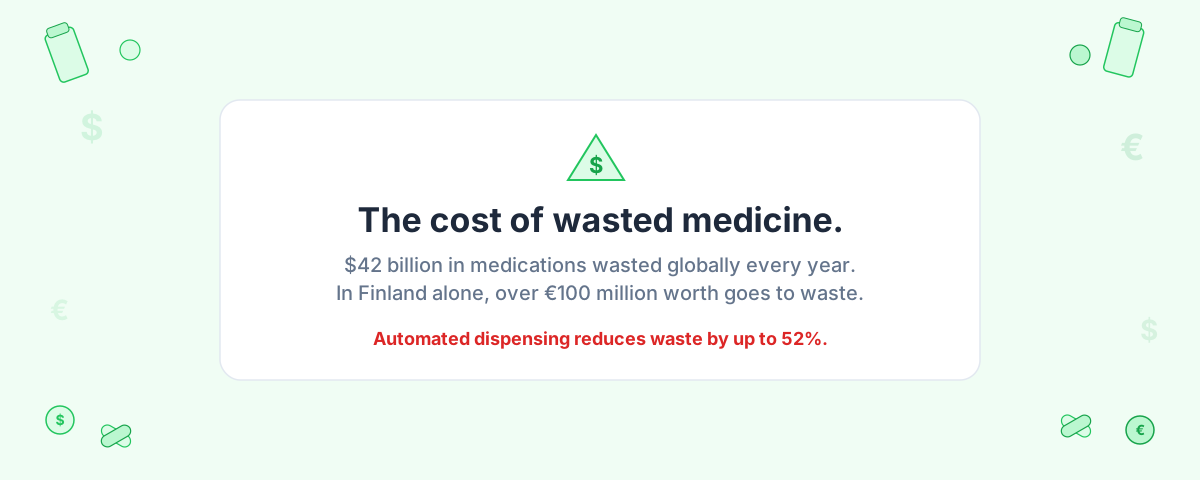
Every year, the global healthcare system throws away $42 billion worth of unused, expired, or improperly dispensed medications (WHO, 2017). This is not a logistics footnote — it is a systemic failure with consequences for patients, healthcare budgets, and the environment.
In the European Union, the European Collaborative Action on Medication Errors and Traceability (ECAMET) estimates that medication waste costs €21.8 billion annually across member states. Finland alone wastes an estimated €100 million or more per year on medications that are dispensed but never used, according to data extrapolated from the Finnish Medicines Agency Fimea and pharmacy return programs.
The Nordic countries — often held up as models of healthcare efficiency — are not immune. In fact, the combination of aging populations, expanding home care, and high polypharmacy rates makes medication waste a growing crisis across Finland, Sweden, Norway, and Denmark.
Medication Waste in Finland and the Nordics
Finland's pharmacy return programs provide a window into the scale of the problem. Fimea reports that Finnish pharmacies collect thousands of tonnes of unused medications annually through the national pharmaceutical return scheme. Much of this waste originates from home care settings, where patients receive multi-week supplies that go partially or entirely unused when prescriptions change, patients are hospitalized, or treatment is discontinued.
In Sweden, the Medical Products Agency (Läkemedelsverket) has estimated that pharmaceutical waste costs approximately SEK 1.3 billion (€115 million) per year. A significant portion comes from the approximately 180,000 patients on automated multidose dispensing (MDD), where sachets containing medications for patients whose prescriptions change mid-cycle must be destroyed entirely — even if only one medication in the sachet has changed.
Across the Nordics, unused medications in home care represent one of the largest and least-visible categories of waste. When a patient on 8 or more medications has even one prescription changed, the remaining pre-dispensed supply of all medications may become unusable. The Nordic pharmaceutical return programs — while among the best in the world for collection rates — address the symptom, not the cause.
The Environmental Impact
Medication waste is not just a financial problem — it is an environmental one. Pharmaceuticals that enter waterways through improper disposal or through the excretion of unused active compounds pose a documented threat to aquatic ecosystems.
A 2019 study published in the Proceedings of the National Academy of Sciences found pharmaceutical compounds in 65% of tested rivers worldwide, with concentrations exceeding safe ecological thresholds in many locations. Nordic countries, despite strong environmental regulations, have detected diclofenac, ethinylestradiol, and antibiotics in surface waters and wastewater effluent (Swedish Environmental Research Institute, IVL).
The European Commission's Strategic Approach to Pharmaceuticals in the Environment (2019) specifically identified unused medications as a key contributor to environmental contamination. The EU Pharmaceutical Strategy adopted in 2020 calls for measures to reduce pharmaceutical waste at the source — not just improve collection and disposal.
In Finland, the Finnish Environment Institute (SYKE) has flagged pharmaceutical residues as an emerging concern for Baltic Sea water quality, where over 100 pharmaceutical compounds have been detected in coastal monitoring programs.
How Waste Happens: The Systemic Failure
Medication waste is not caused by carelessness. It is a structural outcome of how medications are currently dispensed and managed:
Changed prescriptions — When a physician adjusts a patient's medication regimen, any pre-dispensed supply of the old medication becomes waste. In elderly care, prescription changes occur frequently: Finnish nursing home patients average 3.2 medication changes per year (Fimea)
Patient non-adherence — The WHO estimates that 50% of patients in developed countries do not take medications as prescribed. Unused pills accumulate in homes and are eventually returned or discarded
Over-dispensing — Standard practice in many countries is to dispense 30, 60, or 90-day supplies. If a patient's condition changes, treatment is discontinued, or the patient is hospitalized, the remaining supply is wasted
Expired stock — In care facilities, medications held in ward stock expire before use, particularly for less commonly prescribed drugs. Finnish pharmacy audits have found that 12–18% of ward stock in care homes reaches expiration before use
Multi-dose sachet waste — In MDD systems used across the Nordics, a change to any single medication in a multi-drug sachet can require destruction of the entire remaining cycle of pre-packed doses
Unit-Dose Dispensing: Eliminating Waste at the Source
The most effective way to reduce medication waste is to change the fundamental unit of dispensing. Instead of dispensing weeks or months of medication at once, unit-dose dispensing prepares and delivers exactly the medications needed for each administration time — one dose at a time.
This approach addresses every major cause of waste simultaneously:
When a prescription changes, only the current dose is affected — there is no stockpile to discard
Each dose is individually packaged and labeled, eliminating confusion and reducing non-adherence-related waste
Ward stock requirements are dramatically reduced, minimizing expiration losses
Unlike multi-dose sachets, unit-dose systems allow individual medications to be changed without destroying an entire dispensing cycle
The evidence supports this approach. A study in a French geriatric unit (Journal of Evaluation in Clinical Practice, 2014) found that switching from traditional ward stock to automated unit-dose dispensing achieved a 37% reduction in medication waste by volume, in addition to the 53% reduction in administration errors.
Systems that implement full medication traceability — from electronic prescription through automated preparation to barcode-verified administration — have demonstrated a 52% reduction in pharmaceutical waste compared to traditional dispensing workflows (ECAMET White Paper, 2022). The traceability ensures that every dose is accounted for, reducing both errors and the waste that errors generate.
The Path Forward for the Nordics
Finland and the Nordic countries have the infrastructure, the regulatory frameworks, and the political will to lead on medication waste reduction. What is needed now is action:
Adopt unit-dose dispensing in elderly care facilities, where the combination of high polypharmacy rates and frequent prescription changes creates the greatest waste
Transition home care patients from multi-week bulk dispensing to on-demand, individually verified dose preparation
Set measurable waste reduction targets aligned with the EU Pharmaceutical Strategy and the WHO's Medication Without Harm initiative
Integrate waste tracking into pharmacy quality systems, making medication waste as visible and measurable as medication errors
Invest in automated dispensing infrastructure that eliminates the trade-off between medication safety and resource efficiency
The $42 billion question is not whether we can afford to change how medications are dispensed. It is whether we can afford not to.
Sources: WHO Fact Sheet on Medication Safety 2019; WHO Medication Without Harm Initiative 2017; ECAMET White Paper 2022; Fimea (Finnish Medicines Agency) annual reports; Swedish Medical Products Agency (Läkemedelsverket); IVL Swedish Environmental Research Institute; Finnish Environment Institute (SYKE); European Commission Strategic Approach to Pharmaceuticals in the Environment 2019; EU Pharmaceutical Strategy 2020; Journal of Evaluation in Clinical Practice 2014 (French geriatric unit); Proceedings of the National Academy of Sciences 2019 (global river pharmaceutical study); NCBI 2014 (Nordic automated MDD); ADHOC Project (European polypharmacy data).