Medication Safety in Finland and the Nordics: The Data Behind the Crisis
Finland records 15,000 medication safety incidents annually, has the highest elderly polypharmacy rate in Europe at 41%, and 83% of severe medication errors affect patients over 60. This evidence-based report examines the Nordic medication safety challenge — and what the research says about solutions.
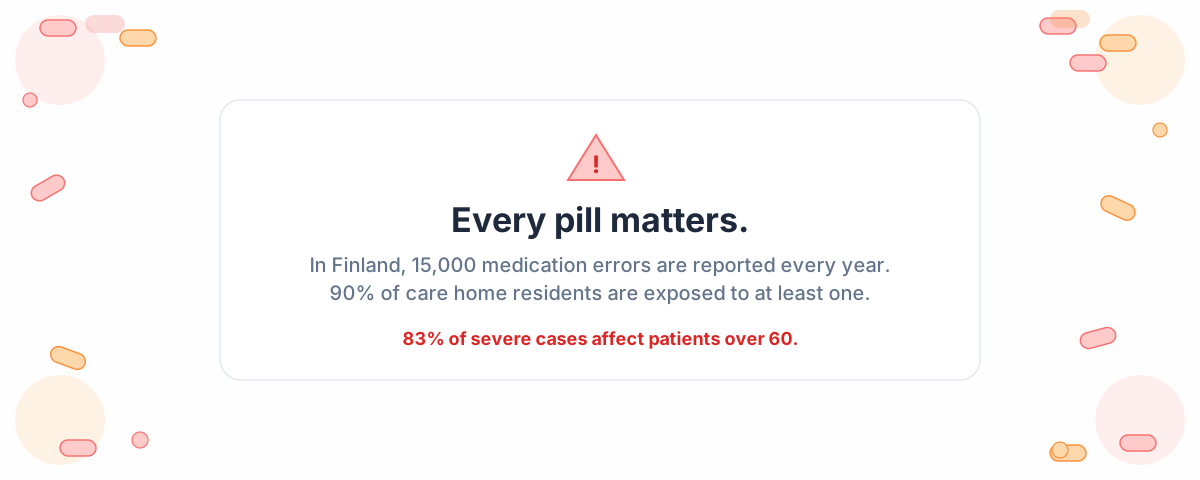
Finland has one of the most advanced healthcare systems in the world. Yet behind the statistics lies a persistent and growing challenge: medication errors continue to harm patients at an alarming rate, particularly among the elderly receiving care at home and in residential facilities.
This report compiles data from Finnish and Nordic health authorities, the WHO, and peer-reviewed medical research to present a comprehensive picture of medication safety in Finland and the Nordic countries — and the evidence for what works.
Finland: 15,000 Medication Safety Incidents Every Year
Finland's national HaiPro incident reporting system — used by over 200 healthcare units — records approximately 15,000 medication safety incident reports annually. These are not minor paperwork issues. According to Finland's national supervisory authority Valvira, medication errors caused death or severe harm in 52% of studied cases (Frontiers in Pharmacology, 2020).
Most critically: 83% of severe medication error incidents concerned patients older than 60 years (Valvira/Frontiers in Pharmacology, 2020). In a country where the elderly population is growing rapidly, this is not a statistic that can be ignored.
The Finnish Medicines Agency Fimea reports that by the end of 2016, 49,500 patients were receiving automated dose dispensing services through community pharmacies — and that number continues to grow. Yet a 2024 study published in BMC Primary Care found that multidose dispensing errors in Finnish community pharmacies increased from 121 in 2015 to 188 in 2020 (relative risk 1.55), driven by the growing volume of patients using the service.
Sweden: 84% of Medication Lists Are Wrong
The situation in Sweden reveals a different but equally concerning dimension of the problem. A 2019 study published in BMC Family Practice examined medication records in Swedish primary health care and found that 84% of medication lists were not consistent with patients' actual medication use — with an average of 3.8 medication errors per medical record.
An analysis of 585 medication errors reported as malpractice cases by Swedish nurses (BMC Health Services Research, 2016) revealed that wrong dose was the most common error at 41% of all cases. The contributing factor in 68% of cases was "negligence, forgetfulness or lack of attentiveness," and in 36% of cases the system factor was "role overload."
Sweden introduced automated multidose drug dispensing (MDD) in the 1980s. By 2011, approximately 180,000 individuals received medicines via automated multidose dispensing, with about 80% aged 65 years or older (Nordic Automated MDD Study, NCBI 2014). Despite decades of use, the challenge of medication accuracy persists.
Norway and Denmark: The Broader Nordic Picture
In Norway, research shows that 27% of elderly patients used at least one potentially inappropriate medication, with about one-third of the elderly population exposed to potentially inappropriate drugs (NCBI, 2009). Elderly females were found to be at particular risk.
Denmark faces challenges at care transitions. A study of 758 patient transfers between primary and secondary care found 142 medication errors — averaging 2 errors per patient transfer. The most common error at hospital admission was inadvertent withdrawal of drugs; at discharge, drugs were erroneously added.
The Polypharmacy Crisis in Finnish Elderly Care
Finland holds a concerning record: it has the highest polypharmacy rate (41%) among 8 European countries studied in the ADHOC project (Aged in Home Care) for elderly home care patients with 9 or more medications. Across European nursing homes in the SHELTER study, 49.7% of residents had polypharmacy and 24.3% had excessive polypharmacy.
Polypharmacy is not just a number — it is the single greatest risk multiplier for medication errors. Every additional medication adds complexity to dosing schedules, increases the risk of drug interactions, and creates more opportunities for human error in dispensing and administration.
What Goes Wrong: The Anatomy of Medication Errors
Data from the WHO, BMC Medicine's landmark 2020 meta-analysis (81 studies, 285,687 patients), and Nordic health systems paint a consistent picture of error types in long-term care:
Omitted doses (40.0%) — the most common error. Medications simply not given on time or at all. In busy care environments with staff shortages, this is the most frequent failure mode (WHO Medication Safety Key Facts, 2019)
Wrong dose (34.7%) — the second most common. In Swedish malpractice data, wrong dose accounts for 41% of reported cases (BMC Health Services Research, 2016)
Wrong time (12.3%) — medication given at incorrect intervals, disrupting therapeutic efficacy
Wrong drug (11.0%) — an entirely incorrect medication is administered to the patient
Wrong route (2.0%) — medication given via the wrong method of administration
In the BMC Medicine meta-analysis, the highest prevalence of preventable medication harm (11%) was observed specifically in elderly care units — followed by ICU (7%), surgical care (6%), and emergency departments (5%).
The Evidence: Automated Dispensing Reduces Errors by 53–80%
The case for automated medication dispensing is supported by rigorous research across multiple countries and care settings:
Key findings from peer-reviewed studies:
Hospital automated dispensing cabinets reduced dispensing errors from 5% to 1% — a 75–80% reduction (Swiss Hospital Study; Taiwan ADC implementation study)
French geriatric unit (Journal of Evaluation in Clinical Practice, 2014): automated unit-dose dispensing system achieved a 53% reduction in medication administration errors compared to ward stock
French pediatric hospital: administration error rates dropped from 24.3% to 9.7% when switching from manual to automated unit-dose systems
ICU implementation (NCBI, 2023): dispensing errors reduced from 3.87 per 100,000 to zero per 100,000 dispensations after automated dispensing cabinet adoption
Full medication traceability systems — electronic prescription + automated preparation + barcode administration + automated dispensing — achieved an overall 58% reduction in medication errors (Boston meta-analysis, cited in ECAMET White Paper 2022)
The ECAMET (European Collaborative Action on Medication Errors and Traceability) White Paper calls for EU-wide adoption of such systems, noting that medication traceability implementation remains low across European hospitals.
Why Finland and the Nordics Must Act Now
The demographic trajectory makes the urgency clear:
Finland's population aged 65+ is projected to grow by over 20% by 2030, increasing the patient volume in home care and residential care settings
Care staff shortages are already acute across all Nordic countries, with role overload cited as a system factor in 36% of Swedish malpractice cases
Home-based care is expanding — but medication safety infrastructure has not kept pace with the shift from institutional to community care
Polypharmacy is increasing as the elderly population grows and medical treatments become more complex
The WHO's Third Global Patient Safety Challenge — "Medication Without Harm" (launched 2017) — set the goal of reducing severe avoidable medication harm by 50%. Achieving this in the Nordics requires not just awareness, but practical solutions that work in everyday care settings: solutions that make medication routines simpler, safer, and more traceable.
Sources: WHO Patient Safety Fact Sheet 2019; WHO Medication Without Harm Initiative 2017; EAASM/ECAMET White Paper 2022; Frontiers in Pharmacology 2020 (Finnish Valvira data); BMC Primary Care 2024 (Finnish community pharmacy errors); BMC Family Practice 2019 (Swedish primary health care); BMC Health Services Research 2016 (Swedish malpractice cases); NCBI 2014 (Nordic automated MDD); NCBI 2009 (Norwegian elderly medication); BMC Medicine 2020 (preventable harm meta-analysis); ADHOC Project & SHELTER Study (European polypharmacy); Fimea (Finnish Medicines Agency); Journal of Evaluation in Clinical Practice 2014 (French geriatric unit); NCBI 2023 (ICU automated dispensing); J. Am. Pharmacists Association 2023 (dispensing error meta-analysis).