Finnish Study Reveals: Each Medication Error Costs €138 – And Only 10% Are Reported
A groundbreaking North Savo study has for the first time calculated the true cost of medication errors in Finnish healthcare. With 130 errors analyzed, an average cost of €138 per incident, and a reporting rate of just 10%, the actual national cost may exceed €150 million annually. The researcher's own recommendation: automated dose distribution.
In March 2026, Yle reported on a landmark Finnish study that for the first time put a price tag on medication errors in the country's healthcare system. The research, conducted by Jonna-Carita Kanninen, PhD, and published in the peer-reviewed journal Health Services Insights, analyzed 130 medication errors reported in the North Savo Wellbeing Services Area during 2023. The findings are striking – and the implications for Finland's healthcare economy are enormous.
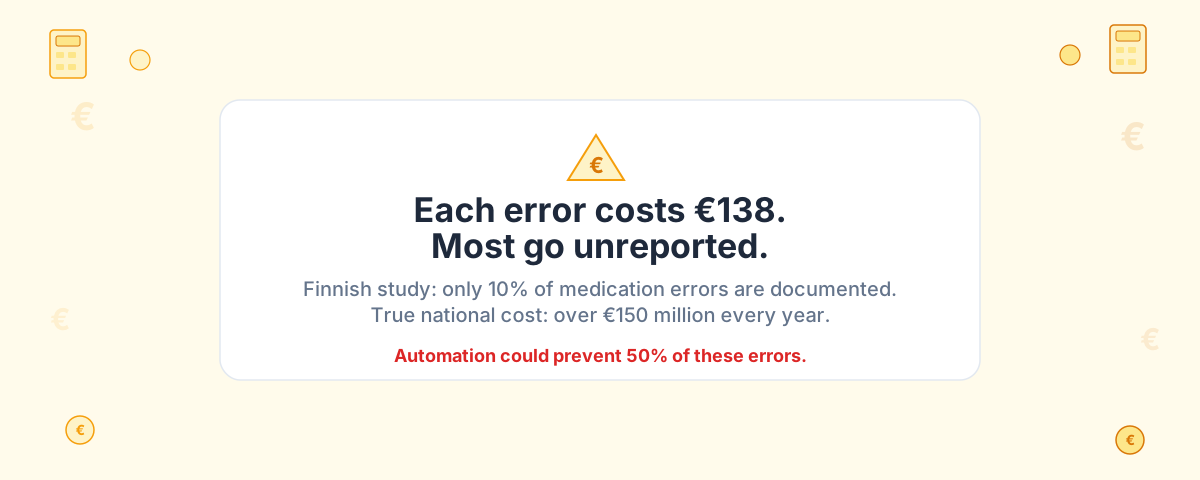
The average cost of a single medication error: €138. The costliest cases reached €4,486 per incident. In North Savo alone, the total reported cost amounted to €686,000 in a single year. When extrapolated nationally, the reported cost reaches approximately €15.5 million per year.
But here is the number that should keep every healthcare decision-maker awake at night: only an estimated 10% of medication errors are ever reported. That means the true annual cost of medication errors in Finland is not €15.5 million – it is more likely €150 million or more.
The Numbers Behind Finland's Medication Error Crisis
Dr. Kanninen's study is the first of its kind in Finland – a systematic analysis of the direct costs generated by medication errors in a single wellbeing services area. Of the 130 errors analyzed:
66% caused direct harm to patients – this is not a matter of near-misses and paperwork. Two out of three errors resulted in actual patient harm
Administration errors accounted for approximately 50% of all errors – wrong medication given, wrong dose administered, or doses omitted entirely
The errors ranged from relatively minor incidents to cases costing thousands of euros in additional treatment, extended hospital stays, and corrective interventions
The study confirms what patient safety researchers have long suspected: medication errors are not rare exceptions. They are a systemic, daily occurrence in Finnish healthcare – and their costs are both measurable and substantial.
€150 Million: The True Cost Nobody Talks About
The €15.5 million national extrapolation is based solely on errors that are actually reported through Finland's HaiPro incident reporting system. But the research literature consistently shows that only about 10% of medication errors are reported. The remaining 90% go undocumented – either because they are not noticed, not recognized as errors, or not reported due to time pressure or fear of consequences.
When we account for this underreporting, the true annual cost of medication errors in Finland rises to an estimated €150 million or more. This figure includes only direct costs – additional treatments, extended hospitalizations, corrective medications, and staff time spent on error resolution. It does not include indirect costs such as lost trust, legal proceedings, long-term patient harm, or the emotional toll on healthcare workers.
To put this in perspective: €150 million per year is roughly equivalent to the annual budget of a mid-sized Finnish wellbeing services area. It is money that is being spent not on improving care, but on correcting preventable mistakes.
Where the Money Goes
The study revealed that each medication error consumes an average of 1.5 hours of staff time to identify, document, investigate, and resolve. This includes time spent on immediate patient assessment, corrective treatment, incident reporting, root cause analysis, and follow-up.
Nurses are involved in 75% of error resolution cases – meaning that the professionals who are already stretched thin by staff shortages and growing patient loads are the ones who bear the greatest burden when errors occur. Every 1.5 hours spent on error resolution is 1.5 hours taken away from direct patient care.
In a healthcare system already struggling with workforce shortages, this hidden time cost is devastating. Across Finland, the cumulative hours lost to medication error resolution likely amount to tens of thousands of nursing hours per year – the equivalent of hundreds of full-time nursing positions.
System Errors, Not Human Failure
Perhaps the most important finding from Dr. Kanninen's research is her characterization of medication errors as "system-originated" rather than the result of individual carelessness or incompetence. This distinction is critical.
When a nurse administers the wrong dose at 3 AM during a shift covering 40 patients, the error is not caused by that nurse's lack of skill. It is caused by a system that relies on manual processes, paper-based verification, and human memory under conditions of fatigue, time pressure, and cognitive overload.
This insight aligns with decades of patient safety research: the most dangerous errors are not the ones caused by bad people, but by good people working in bad systems. The solution is not to train harder or punish more – it is to redesign the system so that errors cannot occur in the first place.
The Solution Is Already Clear
Dr. Kanninen herself points to the answer in her research: automated dose distribution. When the researcher who has spent years analyzing medication errors and their costs identifies automation as the recommended path forward, the message is unambiguous.
MoniDose's automated dispensing ecosystem addresses precisely the error categories that dominate the statistics:
Administration errors – the #1 category at 50% of all errors – are greatly reduced when medication is dispensed automatically with patient-specific verification. The right medication, to the right patient, at the right dose, at the right time
The 1.5 hours of staff time per error is recovered. MoniDose is designed to save 2.5–3.5 hours per nurse per day (our own estimate, not yet field-validated) by automating medication routines – time that would return directly to patient care
Automated dose-event reporting replaces manual incident reporting. Each dispensing event is recorded as the device reports it, building a medication administration trail without requiring additional staff effort
Role-appropriate verification at each step – the pharmacy confirms its own dispensing and order fulfilment, while dose administration is verified and documented by the care team, keeping each part of the chain with the role responsible for it
The 10% reporting rate is itself a symptom of manual systems: when documentation is burdensome and time-consuming, underreporting is inevitable. Automated systems that document every event by default eliminate this gap entirely.
What €150 Million Could Buy Instead
Consider what Finland could do with even a fraction of the money currently lost to medication errors:
If automated dispensing prevented just 50% of medication errors, Finland would save approximately €75 million annually
That is equivalent to funding over 1,500 full-time nursing positions at current salary levels
It could provide automated dispensing services for every home care patient in the country – with budget to spare
It would free up an estimated 75,000+ nursing hours per year currently consumed by error resolution – hours that could be redirected to actual patient care
The economic case for automated medication dispensing is not theoretical. It is documented, peer-reviewed, and now quantified in Finnish data. Every year that passes without systemic adoption of automated dispensing is another year of €150 million in preventable costs, thousands of patients harmed, and tens of thousands of nursing hours wasted.
Dr. Kanninen's study has given Finland the numbers. The question now is whether the healthcare system will act on them.
Sources: Yle 14.3.2026; Kanninen, J-C., Health Services Insights (peer-reviewed); North Savo Wellbeing Services Area HaiPro data 2023; MoniDose component-based savings model.