The €125 Billion Problem: Why Half of All Patients Don't Take Their Medication Correctly
The WHO estimates that 50% of patients with chronic diseases fail to take their medications correctly, costing the EU €125 billion annually. This isn't a patient problem — it's a system failure. This report examines the Nordic adherence gap, why patients stop taking their medication, and the evidence for automated dispensing as a solution.
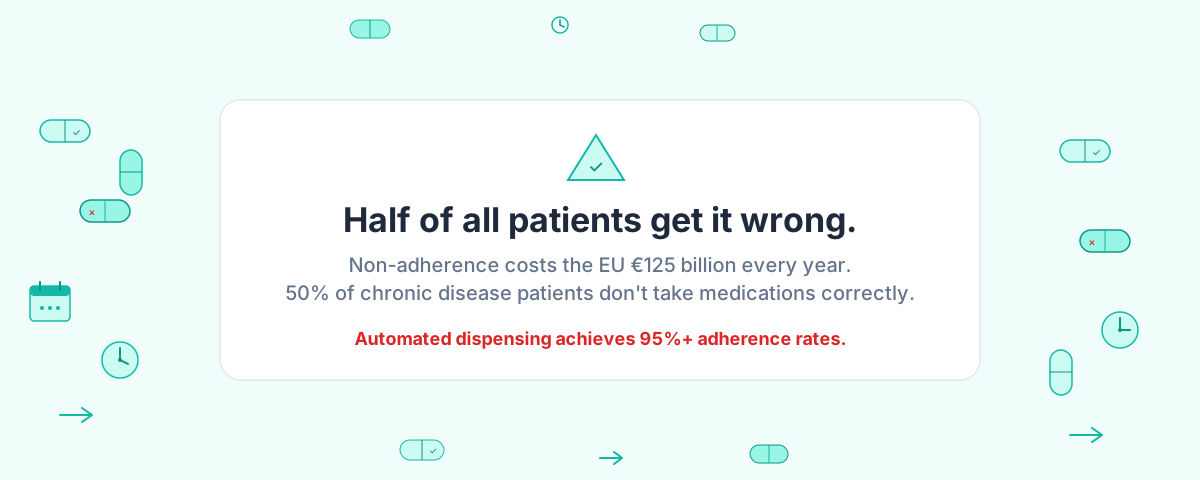
The World Health Organization has called poor medication adherence "a worldwide problem of striking magnitude." In its landmark report *Adherence to Long-Term Therapies: Evidence for Action* (WHO, 2003), the WHO concluded that approximately 50% of patients with chronic diseases do not take their medications as prescribed. Two decades later, the problem has barely improved.
The economic toll is staggering. The OECD estimates that medication non-adherence costs EU healthcare systems €125 billion per year in avoidable hospitalizations, emergency visits, and disease progression (OECD Health Policy Studies, 2018). To put this in perspective: this exceeds the entire annual healthcare budget of most EU member states.
This is not a story about irresponsible patients. It is a story about a healthcare system that hands patients complex medication regimens and expects perfect compliance — without providing the tools to make adherence achievable.
The Nordic Adherence Gap
The Nordic countries are often held up as models of healthcare excellence. Universal coverage, strong primary care, digital health infrastructure — yet medication adherence remains a persistent blind spot.
In Finland, the Finnish Medicines Agency Fimea has documented that adherence among elderly patients with chronic conditions drops to just 40–60%, depending on the disease and medication type. For cardiovascular medications — the most commonly prescribed drug class in Finnish elderly care — adherence rates fall below 50% within the first year of treatment (Fimea Annual Report; European Heart Journal, 2019).
The pattern repeats across the Nordics. In Sweden, the Swedish eHealth Agency reports that approximately 20% of prescriptions are never filled at all — the medication is prescribed but the patient never picks it up from the pharmacy. Among those who do fill prescriptions, adherence drops steadily over time, particularly for asymptomatic conditions like hypertension and hyperlipidemia.
Norway shows similar trends. A study of Norwegian elderly patients found that 30% discontinued cardiovascular medications within the first year, often without informing their physician (Norwegian Institute of Public Health). Denmark, despite its advanced digital prescription system, reports comparable adherence challenges among its aging population.
The paradox is clear: the Nordic countries have built world-class systems for prescribing and dispensing medications, but the last mile — ensuring patients actually take them correctly — remains largely unaddressed.
Why Patients Stop Taking Their Medication
The conventional narrative blames patients: they are forgetful, non-compliant, or willfully ignoring medical advice. The evidence tells a different story entirely.
The WHO identifies five dimensions of adherence, all of which interact:
Patient-related factors — cognitive decline, physical limitations, health literacy, beliefs about medication
Condition-related factors — asymptomatic diseases (hypertension, cholesterol) provide no feedback loop; patients feel fine without medication
Therapy-related factors — complex regimens, side effects, duration of treatment, multiple daily dosing times
Health system factors — fragmented care, poor communication, inadequate follow-up
Socioeconomic factors — medication costs, social support, living conditions
The most powerful predictor of non-adherence is not patient attitude but regimen complexity. A meta-analysis published in the *Annals of Internal Medicine* (2007) found that adherence drops from 79% with once-daily dosing to just 51% with four-times-daily dosing. Every additional medication, every additional dosing time, every additional instruction creates another opportunity for failure.
Consider the reality facing a typical nursing home patient in Finland: the average resident takes 9.1 medications across multiple dosing schedules (SHELTER Study, European nursing homes). Some medications must be taken with food, others on an empty stomach. Some are morning-only, others evening-only, others three times daily. Some require blood level monitoring. Some interact with each other and must be separated by hours.
No human memory system is designed to manage this level of complexity indefinitely — yet that is exactly what we ask of patients, families, and often overwhelmed care staff.
The Human Cost
Poor medication adherence is not merely an economic problem. It is a direct cause of suffering and death.
A landmark study published in the *Annals of Internal Medicine* (2006) analyzing data from 21 observational studies found that non-adherent patients have a 26% higher risk of mortality compared to adherent patients. For cardiovascular medications specifically, the risk increase was even higher.
The European Commission's EU Pharmaceutical Strategy (2020) estimates that 10% of all hospitalizations in the EU are directly linked to medication non-adherence — representing approximately 1.9 million hospital admissions per year. In Finland alone, this translates to tens of thousands of preventable hospitalizations annually.
In Nordic hospitals, the impact is measurable in readmission rates. Finnish hospital data shows that 30-day readmission rates for heart failure patients with poor medication adherence are 2.3 times higher than for adherent patients (Finnish Institute for Health and Welfare, THL). Swedish registry data reveals similar patterns: non-adherent patients with atrial fibrillation have 3 times the risk of stroke compared to adherent patients (Swedish National Patient Register).
The human cost extends beyond mortality statistics:
Unnecessary disease progression — conditions that could be controlled advance because medication is not taken consistently
Avoidable suffering — pain, disability, and reduced quality of life that proper medication use would prevent
Caregiver burden — family members shoulder the stress and guilt when loved ones decline due to medication issues
Loss of independence — medication mismanagement is one of the leading reasons elderly patients lose the ability to live at home
Automated Dispensing: Making Adherence the Default
The fundamental insight of modern adherence research is this: the most effective interventions do not try to change patient behavior — they change the system so that correct behavior becomes the default.
Automated unit-dose dispensing systems represent exactly this approach. Instead of asking patients or care staff to manage complex medication regimens manually, the medications arrive pre-sorted by dose time, individually sealed, and clearly labeled. The patient or caregiver does not need to count pills, read labels, or remember schedules. They simply take the next dose packet.
The evidence is compelling:
Unit-dose systems have been reported to lift adherence into the 90%+ range in some care settings where they are implemented, well above the roughly 50–60% typical of traditional methods (industry and pharmacy-practice literature)
Nordic automated multidose dispensing (MDD) studies show that patients receiving pre-packaged medications demonstrate significantly higher adherence than those using conventional dispensing (NCBI, 2014)
A Swedish study of MDD users (a national programme serving on the order of 180,000 people) found that the system substantially reduced missed-dose errors for patients who received the service, though challenges remain in medication list accuracy (BMC Family Practice, 2019)
Time-stamped dose packaging provides a built-in visual feedback system — patients and caregivers can instantly see whether a dose has been taken or missed
Digital integration — when automated dispensing connects to electronic health records, physicians gain real-time visibility into actual adherence patterns rather than relying on patient self-report
The key principle is simple: make the right thing the easiest thing to do. When taking medication correctly requires no decision-making, no counting, and no complex scheduling, adherence becomes the natural outcome rather than the exception.
Looking Ahead: What Must Change
The €125 billion annual cost of non-adherence is not inevitable. The evidence points clearly to what must change:
Shift from blaming patients to redesigning systems — adherence is a design problem, not a character flaw
Make automated dispensing the standard of care for patients with complex medication regimens, particularly elderly patients with polypharmacy
Integrate adherence monitoring into digital health systems — Finland's Kanta system and Nordic digital health infrastructure provide the foundation, but medication adherence data remains a blind spot
Align reimbursement with outcomes — healthcare payers should recognize that investing in adherence tools saves multiples in avoided hospitalizations and disease progression
Scale Nordic MDD programs — Sweden's 180,000 MDD users represent a fraction of the eligible population; Finland, Norway, and Denmark have similar potential
Support family caregivers — the majority of medication management happens at home, and families need practical tools, not just instructions
Sources: WHO Adherence to Long-Term Therapies: Evidence for Action 2003; OECD Health Policy Studies 2018 (€125 billion estimate); Finnish Medicines Agency Fimea (Finnish adherence data); Swedish eHealth Agency (unfilled prescriptions); Norwegian Institute of Public Health (discontinuation data); Annals of Internal Medicine 2006 (mortality risk meta-analysis); Annals of Internal Medicine 2007 (dosing frequency and adherence); EU Pharmaceutical Strategy 2020 (hospitalization estimates); Finnish Institute for Health and Welfare THL (readmission data); Swedish National Patient Register (atrial fibrillation adherence); SHELTER Study (European nursing home polypharmacy); NCBI 2014 (Nordic automated MDD); BMC Family Practice 2019 (Swedish MDD study); European Heart Journal 2019 (cardiovascular adherence); pharmacy-practice literature (unit-dose adherence estimates).