New tool: Find out in minutes whether MoniDose is right for you or a family member
We have launched a free suitability assessment that helps individuals, families, and care teams decide whether automated medication dispensing would bring real benefit to their situation. The assessment is based on key indicators from the international RAI assessment system and Käypä hoito clinical guidelines. No answers are saved or sent anywhere.
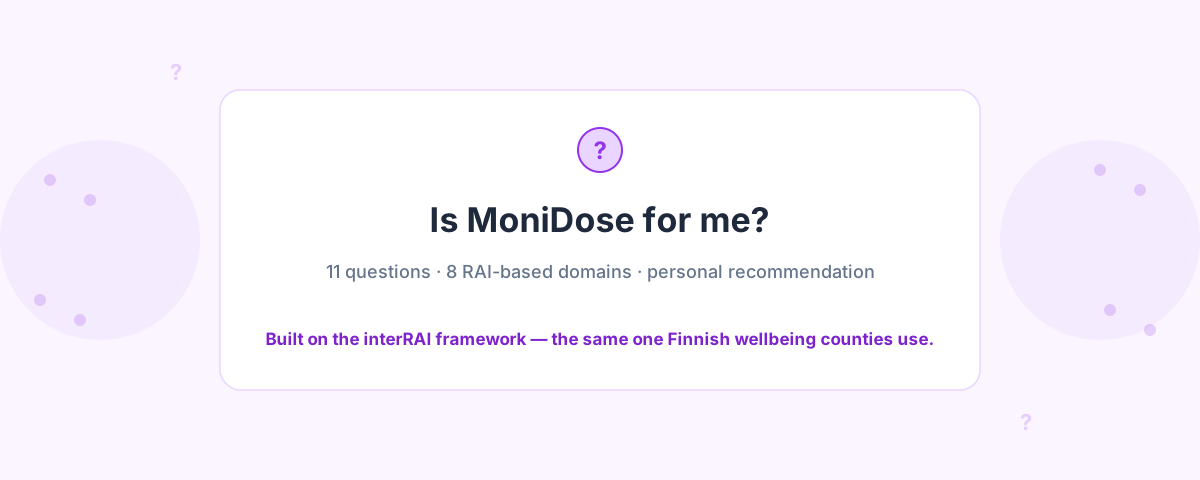
Managing medication can be a routine part of daily life – or it can become a source of worry for the user, family members, and care professionals alike. When is it time to consider automated medication dispensing? Who genuinely benefits from it, and for whom is a manual pill organiser enough? There is no single answer – but now there is a tool that helps you decide quickly and confidently.
Today we are launching a free suitability assessment at monidose.fi/en/is-it-for-me. You answer eleven short questions and receive a personalised recommendation on the spot – no registration, no contact details, no obligations.
Why this tool?
Automated medication dispensing is not right for everyone. With a small medication count and a well-managed routine, a manual pill organiser or weekly dispenser can work perfectly well. On the other hand, when medications are many, doses are regularly missed, or memory impairment begins to affect daily life, an automated dispenser can be crucial – not only as a practical tool but as a support for safety and independence.
The problem is that this line has been hard to identify without a professional's help. Families think about it for months. Nurses hesitate to raise the topic. Users themselves may underestimate the situation. We wanted to make this more transparent.
How the tool works
The questions are built around the RAI assessment system (Resident Assessment Instrument), an internationally recognised framework for evaluating the service needs of older adults. In Finland RAI is a statutory tool used by welfare regions in home care and intensive assisted living, coordinated by THL.
The six assessment areas:
1. Living environment – How the user lives. At home alone, with a spouse, in assisted living, or in a care home? Maps to the RAI-HC Environmental Assessment (Section Q).
2. Care support – What support is available day-to-day. Automated dispensing works best when someone can respond to alerts and handle medication refills. Based on the RAI-HC Social Supports section (Section P).
3. Functional capacity – Memory and daily management. Built on the interRAI Cognitive Performance Scale (CPS, Morris et al. 1994).
4. Medication – Medication count, dosing times, and form. These three questions establish whether the medication profile is one that an automated dispenser can actually support. References: Käypä hoito "Medication in the elderly", Fimea guidance on medication review, and WHO Adherence to Long-Term Therapies (2003).
5. Medication management – Recent adherence and medication changes. Prior management is the strongest single predictor of future adherence. Based on the RAI-HC Medications section (Section M) and WHO adherence framework.
6. Physical function – Vision, hearing, and hand dexterity. Based on the interRAI ADL Hierarchy (Morris et al. 1999).
We also ask two background questions: who is completing the assessment and whether the device is intended for one or two people. These are not scored – they help us offer the right next step.
Step-by-step guide
1. Open the tool. Go to monidose.fi/en/is-it-for-me. The page loads without registration.
2. Read the methodology. At the top of the page a blue panel explains briefly what the assessment is based on. It takes 10 seconds and helps you understand why we ask each question.
3. Select an answer for each question. There are eleven questions, and you advance automatically when you pick an answer. To see why we ask a question, tap "Why do we ask?" – you will see the source it is based on.
4. When unsure. Pick the option that best describes the situation today – not how you wish it were or how it might be in the future. If you do not know the exact medication count, the "do not know" option is perfectly valid.
5. Go back if needed. Every question has a "Previous" link in the bottom-left corner. Your earlier answer is remembered.
6. Read the result carefully. The tenth answer takes you to the result page showing:
Recommended view – what kind of device view would suit the situation best (clear view for one, standard view for one, shared view for two, etc.).
Assessment by area – bars showing how each RAI area scored. You can tap any area to jump back and edit its first question.
Recommendation – one of "Strong fit", "Possibly suitable", "Not immediately relevant", or "Not suitable for pouch-based dispensing".
7. Edit if desired. At the bottom of the result page, an "Edit answers" button takes you back to the first question. Your answers are preserved – you can click through quickly or change any.
8. We save progress automatically. If you close the browser tab mid-assessment, your answers are kept on your device for 24 hours. When you return, a green banner says "We restored your earlier answers". You can continue or start over.
9. Your data stays with you. No answers are sent to a server until you choose to contact us. The assessment runs entirely in your browser.
What the results mean
Strong fit (green badge). Your answers strongly support that automated dispensing would bring meaningful benefit. Recommendation: book a free demo where our specialist walks through personalised suitability.
Possibly suitable (blue badge). Several factors support automation, but some practical arrangements or support structures need clarification. Recommendation: a short assessment conversation by phone or video.
Not immediately relevant (amber badge). The current medication picture looks manageable. A manual pill organiser or weekly dispenser may be enough. This is not "never" – it is "not right now". Return to this assessment if medication count grows, memory declines, or dose-taking becomes inconsistent.
Not suitable for pouch-based dispensing (gray badge). MoniDose dispenses solid medications in multi-dose pouches. If the main medications are liquid or injectable, the device cannot dispense them. Partial automation may still be possible – it is worth discussing with your pharmacy or care provider.
Compatibility with your existing pharmacy
A common worry: do I need to switch pharmacies to use MoniDose? No. The device is designed to work with multi-dose pouch rolls from Finnish pharmacy services – Anja, University Pharmacy (YA), PharmaService, and other common formats are supported. You do not need to change your multi-dose dispensing contract – the device simply joins your existing care chain.
What this tool is NOT
It is not a medical diagnosis. We do not evaluate your health status.
It does not replace an official RAI assessment. A real RAI assessment is always performed by a trained social and healthcare professional at a welfare region or facility.
It is not a sales pitch. A "not right for you right now" outcome is just as valid as "strong fit".
It does not store data. All answers stay in your browser.
If medication management is causing concern, please contact your pharmacy or care provider first.
Who this is for
The tool is built for three audiences:
Individuals and their families. If you or your loved one is wondering whether automated dispensing would help daily life or bring peace of mind around night-time medication, this is the easiest way to get a first indication. Takes under five minutes.
Care professionals. Home-care nurses, service coordinators, and home-services staff can use the tool as a quick complement to a RAI assessment – not replacing it, but as a first pass. When medication support comes up with a client, the assessment helps steer the conversation.
Municipal and welfare-region decision-makers. When preparing service procurements, concrete information about who benefits helps frame decisions. The tool offers a rough picture of who would benefit from automated medication dispensing.
Try the tool
The tool is live at monidose.fi/en/is-it-for-me, free to use and anonymous. Takes about 3–5 minutes, and no data is retained without your explicit decision.
If any question is unclear or you want to share feedback, please write to info@monidose.fi – we are grateful for it.
MoniDose is in development as an EU MDR 2017/745 Class I medical device and is not yet CE-marked. The suitability assessment is intended as an indicative view of whether automated medication dispensing might help – final suitability is always evaluated with a specialist.