The Home Care Revolution: When Care Moves Home, Does Medication Safety Follow?
Finland's home care sector is projected to grow over 40% by 2030 as the Nordic model shifts decisively from institutional to home-based elderly care. But medication safety infrastructure hasn't kept pace. This report examines the gap between home care expansion and medication safety — and what's needed to bridge it.
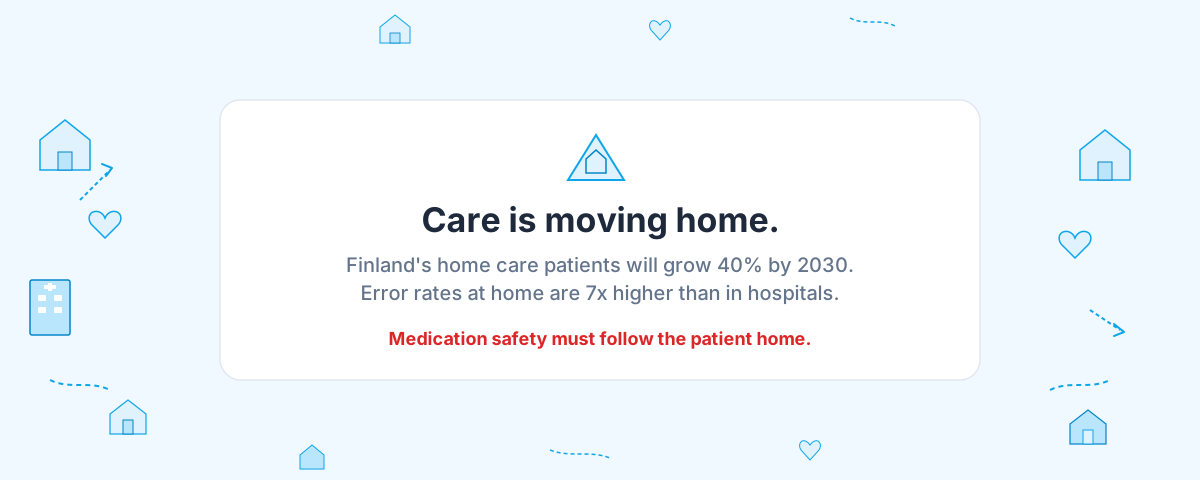
Across the Nordic countries, a fundamental transformation in elderly care is underway. Driven by patient preference, demographic pressure, and cost reality, governments are moving decisively from institutional care toward home-based models. Finland projects a 40% or greater increase in home care volume by 2030 (THL, Finnish Institute for Health and Welfare). Denmark, Sweden, and Norway are on similar trajectories.
The logic is compelling. Patients overwhelmingly prefer to age at home. Home care costs a fraction of institutional placement. And modern digital health tools — in theory — should make it possible to deliver high-quality care outside hospital and nursing home walls.
But there is a critical gap in this vision. While care is moving home, medication safety infrastructure has not followed (OECD Health at a Glance 2023). The systems, protocols, and technologies that protect patients from medication errors in institutional settings largely do not exist in the home care environment. The result is a growing population of vulnerable patients managing complex medication regimens with minimal safety support.
The Nordic Home Care Model
The Nordic countries lead the world in home-based elderly care, and the trend is accelerating.
In Finland, approximately 72% of elderly care is now delivered in home-based settings — a figure that has risen steadily over the past decade and continues to climb (THL, OECD Health Statistics 2023). The Finnish government's SOTE reform, restructuring social and health services into wellbeing services counties, has further reinforced the home-first policy orientation.
Denmark leads the Nordics with approximately 82% of elderly care delivered at home (NOSOSCO, Nordic Social Statistical Committee). The Danish model — often cited internationally as a benchmark — emphasizes rehabilitation, independence, and technology-enabled home support. Sweden and Norway fall between these figures, with both countries at approximately 75% home-based care.
The policy drivers are consistent across the region:
Patient preference — surveys consistently show that 85–90% of elderly people prefer to remain in their own homes (Eurobarometer, 2021)
Cost efficiency — home care costs approximately €50–80 per day compared to €200–350 per day for residential nursing home care in the Nordics (OECD, 2023)
Demographic necessity — with elderly populations growing 20–30% by 2030, there are simply not enough institutional beds or staff to maintain the old model
SOTE reform implications — Finland's wellbeing services counties are tasked with delivering more care with constrained budgets, further incentivizing home-based approaches
The economic argument is overwhelming. But cost savings only materialize if home care is delivered safely. And on medication safety, the evidence raises serious concerns.
The Medication Safety Gap at Home
The shift to home care has created what researchers call "the medication safety gap" — the difference between the safety protections available in institutional settings and those available at home.
The numbers are stark. A landmark meta-analysis published in BMC Medicine (2020), covering 81 studies and 285,687 patients, found that medication error rates are dramatically higher outside supervised hospital environments. In hospital settings with supervised medication administration, error rates average approximately 3.2%. In home and community settings with self-administration, error rates rise to 21.7% — nearly seven times higher.
This gap exists because institutional care provides multiple safety layers that home care lacks:
Double-checking protocols — in hospitals and nursing homes, medication preparation and administration typically involve verification by a second professional. At home, there is usually no second check
Controlled storage — institutional settings maintain proper medication storage, separation, and labeling. Home environments are uncontrolled
Professional oversight — nurses in care facilities observe medication administration and can catch errors in real time. Home care nurses visit intermittently, often only once or twice per day
Electronic systems — hospitals increasingly use barcode verification and electronic medication administration records. These systems rarely extend to home care
Structured schedules — institutional care follows rigid medication administration times. At home, schedules drift based on patient routines and caregiver availability
The result: as patients transition from institutional to home care, their medication safety drops significantly — precisely when many of them are managing the most complex medication regimens of their lives.
Nordic Home Care in Numbers
A comparative view of Nordic elderly care reveals both the scale of the home care shift and the variation between countries:
Finland — 72% home-based elderly care, 28% institutional. Approximately 200,000 elderly receiving regular home care services. Finnish home care patients typically carry a heavy medication load — Finnish home-care research (FIMA study) puts the mean at around a dozen or more medications per patient
Denmark — 82% home-based, 18% institutional. Approximately 150,000 receiving home care. The most digitally integrated home care system in the Nordics (NOSOSCO, Danish Health Data Authority)
Sweden — 75% home-based, 25% institutional. Approximately 230,000 home care recipients. 180,000 already receiving automated multidose dispensing (SKR, Swedish Association of Local Authorities and Regions)
Norway — 74% home-based, 26% institutional. Approximately 190,000 home care recipients. Strong focus on welfare technology integration (Norwegian Directorate of Health)
Across all four countries, the trend is the same: home care is growing, institutional care is shrinking, and the elderly patients at home are managing increasingly complex medication needs with limited safety infrastructure.
The Missing Link: Technology in Home Medication
The irony of Nordic home care is that these countries are global leaders in digital health — yet the most fundamental daily healthcare task in home settings, medication management, remains largely analog.
The current state of home medication management for most Nordic elderly patients looks like this:
Manual pill organizers — plastic weekly boxes filled by the patient, a family member, or a visiting nurse. Error-prone, unverified, and providing no adherence data
Family caregivers as pharmacists — spouses and children who manage medication sorting and administration, often without training and under significant stress
Sporadic nurse visits — home care nurses who visit once or twice daily, spending a disproportionate amount of their limited time on medication tasks rather than clinical assessment
Paper-based documentation — medication changes communicated by phone, fax, or paper, with delays and transcription errors at every handoff
Denmark has made the most progress on digital health integration, with the Sundhed.dk portal providing patients digital access to their medication records. Finland's Kanta system — a nationally integrated health data platform — provides a strong digital backbone, including the electronic prescription service and patient data repository. But in both cases, the digital systems stop at the pharmacy door. The "last mile" — ensuring medications are correctly sorted, timed, and taken in the patient's home — remains an analog process.
Sweden's experience offers a glimpse of what technology-enabled home medication can look like. With 180,000 patients receiving automated multidose dispensing, Sweden has the largest MDD program in the Nordics. Studies show that MDD patients have significantly fewer missed-dose errors, though challenges remain in keeping medication lists accurate and up to date (NCBI, 2014).
The gap is clear: Nordic countries have built digital highways for prescription data, but the last mile of medication delivery and administration at home remains a dirt road.
Bridging the Gap
The solution is not to slow the shift to home care — it is to ensure that medication safety moves home with the patient.
Automated medication dispensing represents the critical bridge between institutional safety standards and home-based independence. When medications are pre-sorted into individual dose packets, labeled with time and contents, and sealed for safety, the home environment inherits many of the safety features previously available only in institutional settings:
Correct sorting is guaranteed by automated systems, eliminating the manual errors that plague pill organizers
Dosing schedules are built into the packaging — each packet shows when it should be taken, removing the cognitive burden of remembering complex schedules
Missed doses become visible — sealed packets that should have been opened provide immediate, visual evidence of non-adherence
Family caregivers are supported — instead of sorting and counting pills, caregivers simply ensure the next packet is taken on time
Nurse visit time is freed — when medication sorting is handled by automation, visiting nurses can focus on clinical assessment, wound care, and patient communication
The evidence from Sweden's MDD program supports this vision. Among the 180,000 patients receiving automated dispensing, studies document significantly improved adherence rates and reduced medication errors compared to conventional dispensing (Nordic Automated MDD Study, NCBI 2014). The Swedish experience demonstrates that automated dispensing is both scalable and effective in home settings.
The vision is straightforward: hospital-grade medication safety in every home. Not through expensive hospital equipment, but through dose-dispensed packaging, digital integration, and automated systems that make the safe thing the simple thing.
What Must Change
The home care revolution is not optional — demographics and economics have made it inevitable. What remains a choice is whether medication safety keeps pace. The evidence demands action on several fronts:
Make automated dispensing a standard home care service — not a premium add-on, but a default for patients with polypharmacy
Integrate medication dispensing with Kanta and Nordic digital health systems — real-time medication data should flow from pharmacy to home to physician
Redesign home care nurse workflows — free nursing time from medication sorting so it can be used for clinical tasks that require human judgment
Establish medication safety standards for home care equivalent to those in institutional settings — the location of care should not determine the level of safety
Support family caregivers with practical tools — training alone is insufficient; caregivers need systems that make correct medication management achievable
Scale Sweden's MDD success across the Nordics — Finland, Denmark, and Norway can learn from and build on Sweden's three decades of automated dispensing experience
Sources: THL Finnish Institute for Health and Welfare (home care statistics, SOTE reform); OECD Health at a Glance 2023 (care models, cost comparisons); NOSOSCO Nordic Social Statistical Committee (Nordic care comparison); BMC Medicine 2020 (medication error meta-analysis, 81 studies); Fimea Finnish Medicines Agency (medication data); Danish Health Data Authority (Sundhed.dk); Finnish Kanta system (digital health infrastructure); NCBI 2014 (Nordic automated MDD study); SKR Swedish Association of Local Authorities and Regions (Swedish home care data); Norwegian Directorate of Health (welfare technology); BMC Family Practice 2019 (Swedish MDD medication lists); Eurobarometer 2021 (patient preference surveys); SHELTER Study (nursing home polypharmacy).