Designed for the most vulnerable: why accessibility-first medication technology matters
150,000 Finns live with memory disorders. People with dementia are 3x more likely to struggle with medication packaging. Technology designed for the most vulnerable works better for everyone.
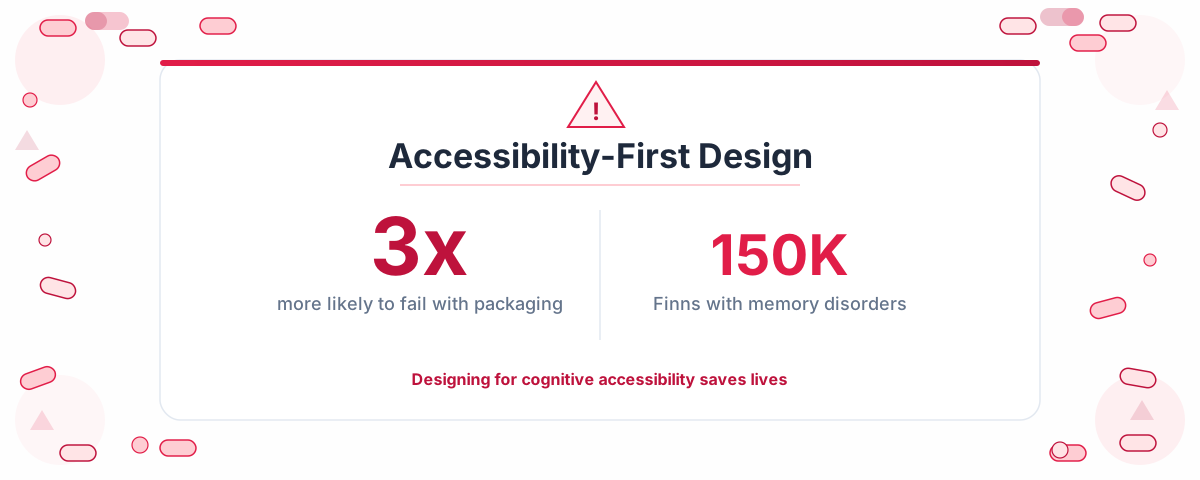
There are 57 million people living with dementia worldwide. The WHO projects this will reach 78 million by 2030 and 139 million by 2050. In Finland alone, approximately 150,000 people live with diagnosed memory disorders, with 23,000 new diagnoses every year (THL). (Broader prevalence counts that include every stage from mild cognitive impairment upward put the figure closer to 193,000 — Alzheimer Europe, 2019.) These are not edge cases. These are the people medication technology must work for first — not last.
The global cost of dementia care reached $1.3 trillion in 2019 (WHO), and approximately 70% of Nordic dementia patients are cared for at home. The women in their lives — wives, daughters, home care workers — provide 70% of all care hours (WHO). When medication technology fails these patients, it fails entire families.
Yet most medication packaging, pill organizers, and health apps are designed for people with full cognitive capacity, good eyesight, steady hands, and smartphone experience. The result is technology that excludes precisely the people who need it most.
The packaging problem — 3x more likely to fail
A study published in Age and Ageing (PMC5396255) found that people with dementia are 3 times more likely to be unable to remove medicines from their packaging compared to cognitively healthy adults. Blister packs require fine motor coordination and the ability to apply targeted pressure. Child-resistant caps demand a precise push-and-turn sequence. Even simple screw caps become barriers when hand strength diminishes and cognitive sequencing fails.
This is not a minor inconvenience. When a person cannot physically access their medication, every downstream safety measure becomes irrelevant. It does not matter how precisely a pharmacist has counted the pills or how carefully a physician has calibrated the dose — if the patient cannot get the medicine out of the package, the treatment fails.
Non-adherence rates among cognitively impaired patients range from 10.7% to 38% (PMC5293218), driven in large part by these physical and cognitive barriers. These are not patients choosing to skip medication. These are patients defeated by design.
The packaging problem compounds with disease progression. In early-stage dementia, a patient may struggle occasionally. By moderate stages, independent medication access becomes unreliable. By severe stages, it is impossible. Yet the packaging remains the same throughout — designed for the general population, not for the people whose lives depend on it.
The color that kills — when pink looks blue
Color vision deficiency affects 8% of men and 0.4% of women from birth. But the age-related dimension is far more significant for medication safety: by the mid-70s, studies suggest a large share of people — on the order of a third to a half — experience meaningful color vision changes due to yellowing of the lens, reduced cone function, and other age-related optical changes.
A study published in The Lancet (2009) documented that 2% of color-blind individuals confuse their medications based on color alone. The specific finding is striking: pink tablets appear blue to people with red-green color deficiency — the most common form. In a medication regimen where a pink blood pressure tablet sits alongside a blue sleep medication, this confusion is not theoretical. It is a daily risk.
Pharmaceutical manufacturers rely heavily on color coding to differentiate products. Pharmacies organize by color. Patients learn their medications as "the little pink one" and "the blue oval." When that color perception fails — whether from congenital deficiency or age-related decline — an entire layer of safety identification disappears.
For dementia patients with co-occurring color vision changes, the compounding effect is severe. A patient who cannot remember which medication is which, and also cannot distinguish them by color, has lost both their primary and secondary identification systems. The only remaining safeguard is the caregiver — who may also be elderly and may also have diminished color vision.
Designing for cognition, not just compliance
Traditional medication adherence technology focuses on compliance: did the patient take the pill? Reminders beep. Apps send notifications. Pill boxes have compartments labeled with days.
But for a person with dementia, compliance-focused design misses the point entirely. The problem is not that the patient forgot a reminder. The problem is that the patient may not understand what the reminder means, may not remember what to do in response, may not be able to physically execute the required steps, and may not recognize that anything has gone wrong.
Designing for cognition means something fundamentally different:
• Reducing decision points to zero — instead of asking "which pills do I take now?", the system presents exactly one option at exactly the right time. No selection. No counting. No interpretation • Using physical affordances rather than digital interfaces — tactile cues, clear visual contrast, intuitive opening mechanisms that work with impaired fine motor control • Designing for progressive decline — a system that works for mild cognitive impairment today must still work for moderate dementia in two years, and must gracefully hand control to a caregiver in severe stages • Providing passive confirmation — rather than requiring the patient to press a button or check a box, the system detects that a dose has been taken and communicates this to caregivers automatically • Eliminating the need for technology literacy — no apps to download, no passwords to remember, no touchscreens to navigate
Research on automatic medication dispensers for Alzheimer's patients demonstrates this approach works: studies found that such devices helped patients maintain therapy for 3 to 4.5 years at home — years that would otherwise have been spent in institutional care. Furthermore, 84% of users wanted to continue using the dispensing devices, indicating that accessible design is not merely tolerated but valued.
The curb cut effect — accessible design benefits everyone
In the 1970s, disability activists in Berkeley, California, campaigned for small ramps — curb cuts — at street intersections. The ramps were designed for wheelchair users. But something unexpected happened: 9 out of 10 unencumbered pedestrians now use curb cuts (Blackwell, Stanford Social Innovation Review). Parents with strollers. Delivery workers with hand trucks. Travelers with rolling suitcases. Runners. Cyclists. The design solved a problem for a few and improved life for everyone.
This phenomenon — the curb cut effect — is the strongest argument for accessibility-first design in medication technology. When you design a medication system that works for a person with moderate dementia, you create a system that is:
• Simpler for every elderly patient — even those without cognitive impairment benefit from reduced complexity • Safer for patients with multiple chronic conditions — polypharmacy patients juggling 8–12 medications need the same cognitive offloading that dementia patients require • Easier for caregivers — whether family members or professional care workers, simpler systems mean fewer errors and less training • More intuitive for visually impaired users — high-contrast design and tactile cues help everyone in low-light conditions • Less stressful for time-pressed nurses — a system that takes 10 seconds instead of 3 minutes per patient transforms a care worker's entire shift
Research from the PMC3570931 study on universal design found that 75% of middle-aged and older adults want to remain in their current homes as they age. The technology that enables this must work across a wide spectrum of ability — not just for the healthiest, most digitally literate elderly.
The alternative — designing for the average user and then retrofitting accessibility — consistently produces inferior results. Features added as an afterthought feel like afterthoughts. Interfaces simplified after the fact carry the complexity of their original design. Accessibility bolt-ons work poorly because they were never part of the core architecture.
MoniDose's approach: designed for those who never touched a smartphone
MoniDose was not built for the general population and then adapted for vulnerable users. It was designed from the ground up for the most challenging use case: a person with dementia who has never touched a smartphone, living at home, cared for by an aging spouse.
This design philosophy produces specific, measurable outcomes:
• Accessibility options specifically developed for dementia patients — not generic "large font" settings, but fundamental interaction patterns designed around progressive cognitive decline • Colorblind-safe design — critical medication information is never conveyed by color alone, ensuring safety for the 8% of men with congenital color deficiency and the large share of elderly affected by age-related color vision changes • Daily interaction comfort as a design goal — tested in sessions with target-group participants, including elderly people with no prior technology experience. The aim is not just usability but emotional comfort: the absence of anxiety, confusion, and frustration • Zero smartphone dependency — the system works for people who have never owned a smartphone, never downloaded an app, never created a password. Digital literacy is not a prerequisite for medication safety
This approach inverts the standard technology development model. Instead of building for early adopters and hoping accessibility follows, MoniDose builds for the least-served users and lets the benefits flow to everyone else. The result is a system that professional nurses find effortlessly intuitive — because it was designed for people facing far greater cognitive challenges than a busy workday.
Keeping people at home, safely
The ultimate goal of accessibility-first medication technology is not technological. It is human: keeping people in their homes, with their families, in their communities, for as long as safely possible.
The data supports this goal. Automatic medication dispensers have helped Alzheimer's patients maintain therapy and remain at home for 3 to 4.5 years longer than would otherwise be possible. In Finland, where approximately 150,000 people live with memory disorders and 23,000 receive new diagnoses every year, each year of safe independent living represents both a personal victory and a systemic saving.
When 70% of Nordic dementia patients are cared for at home and women provide 70% of those care hours, accessible medication technology is not a luxury — it is infrastructure. It supports the caregiver as much as the patient. It reduces the daily anxiety of "did she take her pills?" to a confirmed data point. It transforms medication management from a source of family conflict and stress into a solved problem.
The dementia population will grow — from 57 million globally today to 139 million by 2050. The care workforce will not grow proportionally. The gap must be filled by technology that truly works for the people it claims to serve: not the digitally fluent, not the cognitively sharp, not the young and healthy — but the vulnerable, the impaired, the forgotten.
Technology designed for the most vulnerable works better for everyone. That is not idealism. It is engineering.
Sources: WHO Global Status Report on the Public Health Response to Dementia (57M global prevalence, 78M by 2030, 139M by 2050, $1.3 trillion global cost, women providing 70% of care hours); THL Finnish Institute for Health and Welfare (150,000 with diagnosed memory disorders in Finland, 23,000 new diagnoses/year); Alzheimer Europe 2019 (broader ~193,000 prevalence including all stages); PMC5293218 (non-adherence rates 10.7%–38% among cognitively impaired); PMC5396255 / Age and Ageing (3x more likely unable to remove medicines from packaging); The Lancet 2009 (2% medication confusion among color-blind, pink-blue misidentification); PMC3570931 (75% of older adults want to age in current homes); Blackwell, Stanford Social Innovation Review (curb cut effect, 9 of 10 pedestrians use curb cuts); Studies on automatic medication dispensers for Alzheimer's patients (3–4.5 years maintained therapy at home, 84% wanted to continue); Color vision deficiency prevalence (8% men, 0.4% women congenital; age-related decline in a large share of elderly — estimate); MoniDose user research (comfort-first design principles, accessibility features for dementia and colorblind users).