Connected Care: Why Medication Safety Fails When Systems Don't Talk to Each Other
A prescription is written by a doctor. A pharmacy prepares the dose. A nurse administers it. A family member worries. A patient takes — or doesn't take — the medication. Five stakeholders. Zero shared real-time visibility. This report examines why medication errors persist even when every individual actor in the chain does their job correctly.
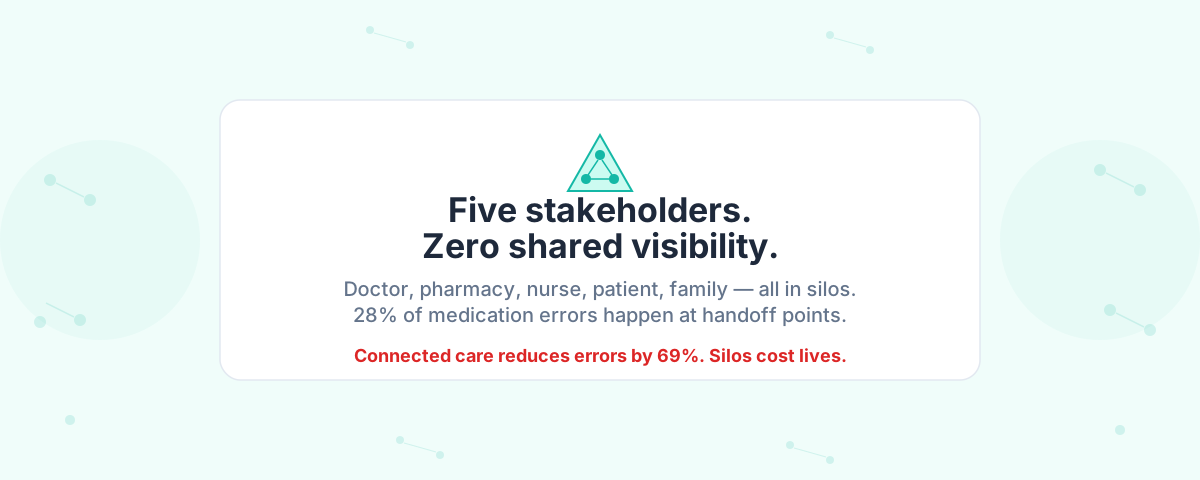
A prescription is written by a doctor. A pharmacy prepares the dose pouch. A nurse delivers it. A family member calls to check in. A patient takes — or doesn't take — the medication.
Five stakeholders. Five separate information systems. Zero shared real-time visibility.
This is the fundamental architecture of medication management in Finland and across the Nordics. And it is why medication errors persist despite every individual stakeholder doing their job correctly. The problem is not incompetence. The problem is not negligence. The problem is that information does not flow between the people who need it, when they need it.
Every stakeholder operates in their own silo, with their own records, their own view, and their own assumptions about what everyone else knows. The result: a system that looks functional from any single vantage point but is dangerously fragmented when viewed as a whole.
The Silo Problem
Each stakeholder in the medication chain works within a closed information loop. The boundaries between these loops are where errors are born.
The doctor writes or modifies a prescription in the electronic health record. They see the patient's diagnosis, lab results, and medical history. They do not see whether the patient has been taking their current medication. They do not know that the patient has 14 days of pre-prepared dose pouches that don't reflect the new prescription. They assume the pharmacy will handle the transition. They move on to the next patient.
The pharmacy receives the prescription electronically — sometimes within hours, sometimes after a delay of 24-48 hours depending on the system. The pharmacy sees the prescription. They do not see the patient's daily adherence. They do not know if the patient understood the doctor's changes. They prepare the next batch of dose pouches according to the updated prescription and ship them. They assume the old pouches will be removed. They have no way to verify this.
The nurse receives the dose pouches and manages their administration during scheduled visits. The nurse sees the pouches and the patient. They may or may not have seen the updated prescription in the nursing information system. If the prescription changed between pharmacy delivery cycles, the nurse may be administering an outdated medication set without knowing it. They assume the pouches are correct because they came from the pharmacy.
The family sees the patient — perhaps daily, perhaps weekly, perhaps only by phone. They know their loved one "takes medication" but have no visibility into what, when, or whether. They assume the professionals have it under control. They worry, but they have no information to act on.
The patient takes what's in front of them — or doesn't. They may not understand why a medication changed. They may not notice that a new drug was added or an old one removed. They may feel side effects but not connect them to a medication change. They assume their doctors and pharmacists know what they're doing.
Every assumption in this chain is reasonable. Every assumption is also potentially wrong. And there is no mechanism to verify any of them in real time.
The Danish Evidence
The consequences of siloed medication management are not theoretical. They have been meticulously documented.
A landmark Danish study (Pharm World Sci, 2008) examined 758 patient transfers between care settings — hospital to home, home to hospital, between wards. The researchers found 142 medication errors: roughly one error per five transfers. The most common error types reveal the silo problem with painful clarity:
Drugs inadvertently withdrawn at admission. A patient arrives at the hospital. The admitting physician reviews the hospital records but doesn't have complete information about medications added by the GP or managed by the home care pharmacy. Medications are dropped from the active list — not because anyone decided to stop them, but because the information didn't transfer.
Drugs erroneously added at discharge. A medication given temporarily during hospitalization (a short-course antibiotic, a post-surgical painkiller) appears on the discharge summary and gets incorporated into the ongoing medication list. The pharmacy prepares dose pouches including a drug the patient no longer needs. The error persists until someone notices — which may be weeks or months.
Dose discrepancies. A dose was adjusted during hospitalization but the adjustment didn't propagate to the community pharmacy. The patient goes home on the old dose, undermining the clinical decision that was made.
Timing conflicts. A medication was moved from morning to evening administration during hospital care, but the dose pouches continue to include it in the morning set. The patient takes it at the wrong time, reducing its effectiveness or causing unnecessary side effects.
Every one of these errors occurs at a boundary between silos. Inside any single silo, the work is done correctly. The errors live in the gaps between them.
What Real-Time Visibility Changes
When all stakeholders share the same real-time information about medication status, the entire error landscape transforms.
Prescription changes propagate instantly. The moment a doctor modifies a prescription, every stakeholder — pharmacy, nurse, family, patient — knows. No 48-hour delay. No phone chains. No assumptions.
Intake confirmation flows to everyone who needs it. When a patient takes their dose, the nurse sees it. The pharmacy sees it. The family sees it. The doctor can review adherence patterns. No single stakeholder is operating on assumptions.
Missed doses trigger immediate response. A dose is expected at 10pm. It doesn't happen. Within minutes — not hours, not the next morning — the responsible parties know. A nurse can call. A family member can check. An alert can escalate. The window between error and intervention shrinks from hours to minutes.
Patterns become visible. A patient who consistently misses Friday evening doses. A patient whose adherence drops when their regular nurse is on leave. A patient who takes morning doses reliably but forgets every evening dose. These patterns are invisible when information is trapped in silos. They become obvious when data flows freely.
Transitions stop being dangerous. When a patient moves from hospital to home, every stakeholder sees the same medication list in real time. Discrepancies are flagged automatically. No drugs are inadvertently dropped. No temporary medications become permanent by accident.
Who Sees What Today — And Who Should
The current state of medication visibility across stakeholders is a patchwork of partial information:
The doctor sees the prescription they wrote and lab results. They do not see adherence data, pharmacy dispensing status, or nurse administration records in real time. Their view is clinical but disconnected from operational reality.
The pharmacy sees the prescription and their own dispensing records. They do not see whether doses were taken, whether the patient is experiencing side effects, or whether a nurse has flagged a concern. Their view is logistical but ends at the point of delivery.
The nurse sees what's in front of them during their visit — the patient, the dose pouches, their nursing notes. They may have access to the prescription via their nursing information system, but often with a delay. They do not see the pharmacy's dispensing timeline or the family's observations. Their view is episodic — limited to the moments they are physically present.
The family sees almost nothing formally. They may know what medications their loved one takes, but they have no real-time access to adherence data, prescription changes, or nurse observations. Their view is emotional and unstructured — based on phone calls, visits, and hope.
The patient may have a medication list, but may not understand it. They have no dashboard showing their adherence, no alerts about changes, no connection to the professionals managing their care. Their view is personal but isolated.
What every stakeholder should see: the same real-time picture. Not all the same details — a family member doesn't need to see lab results, a pharmacist doesn't need nursing notes — but the same core medication status: what was prescribed, what was dispensed, what was taken, and when.
The Nordic Model: Built for Connection
The Nordic countries have built the digital infrastructure that makes connected medication care possible. The foundations are already in place.
Finland's Kanta system provides a national electronic health record and e-prescription service. Every prescription written in Finland flows through Kanta. The data architecture exists for nationwide medication visibility — but Kanta operates at the prescription level, not the operational level. It knows what was prescribed. It does not know what was taken.
Denmark's Sundhedsplatformen and the broader Danish e-health infrastructure have pushed further into integrated health records. The Danish experience — including the care transition study documenting roughly one medication error for every five transfers — has driven awareness of the need for operational-level integration.
Sweden's e-health initiatives under Inera and the Vision for eHealth 2025 framework have established interoperability standards that enable data sharing across care settings. Sweden's experience with Pascal (the national dose dispensing system) has highlighted both the potential and the current limitations of automated dispensing without intake confirmation.
Norway's national health network (Norsk Helsenett) connects healthcare providers digitally and has enabled significant progress in e-prescriptions and medication reconciliation.
The regulatory frameworks exist. The digital infrastructure exists. The e-prescription systems exist. The automated dose dispensing systems exist. What is missing is the operational layer — the connection between the point of dispensing and every stakeholder who needs to know what happened after that point. The infrastructure carries prescriptions beautifully. It does not carry confirmation.
What Connected Care Actually Looks Like
Connected medication care is not a single app. It is not a patient portal that nobody checks. It is not another login for overworked nurses. It is a system — a layer of real-time information flow — that makes the existing infrastructure complete.
In a connected system:
The pharmacy sees confirmation that doses were taken. Returns drop. Waste decreases. Phone calls to nurses become unnecessary. The pharmacist's time shifts from logistics to clinical services.
The nurse sees real-time medication status for every patient on their caseload — before they leave for their round. They know which patients need attention and which are on track. Visits become purposeful. The nurse's time shifts from verification to care.
The family gets peace of mind. Not a daily phone call asking "did you take your medication?" but actual information: "Your mother took all her doses today." The family's experience shifts from anxiety to confidence.
The doctor sees adherence data at the next appointment. Not "the patient says they've been taking their medication" but actual records. Clinical decisions improve because they're based on facts, not self-reports. The doctor's prescribing shifts from guessing to knowing.
The patient gets independence with safety. Not constant supervision but quiet monitoring. Not nagging reminders but appropriate support. The ability to live at home, manage their own medication, and know that if something goes wrong, someone will know. The patient's experience shifts from dependence to autonomy.
This is what connected care means: not connecting systems to systems, but connecting people to information. Every stakeholder sees what they need to see, when they need to see it. The gaps between silos close. The errors that live in those gaps disappear.
The ECAMET White Paper (2022) identified this exact gap as the critical barrier to medication safety improvement across Europe: not the quality of individual care, but the absence of operational connectivity between care actors. The OECD's health analyses consistently show that countries with higher levels of care integration achieve better outcomes at lower cost — not because individual providers are better, but because information flows.
The Nordic countries are uniquely positioned to lead this transformation. The infrastructure is built. The regulatory frameworks support it. The population is digitally literate. The care models are already organized around coordination. The missing piece is operational — connecting the last step, the actual moment of medication intake, to every stakeholder who needs to know.
Sources: Danish care transition study (Pharm World Sci, 2008) — 758 transfers, 142 medication errors; ECAMET White Paper 2022 — European medication management integration framework; OECD Health at a Glance — care integration and outcome analysis; Nordic Council of Ministers — cross-border e-health cooperation reports; Finnish THL — Kanta system utilization and home care statistics; Sweden's Inera — interoperability framework and Pascal dose dispensing data; WHO Medication Without Harm Initiative 2017.