Burned Out and Understaffed: How Medication Tasks Are Breaking Nordic Care Workers
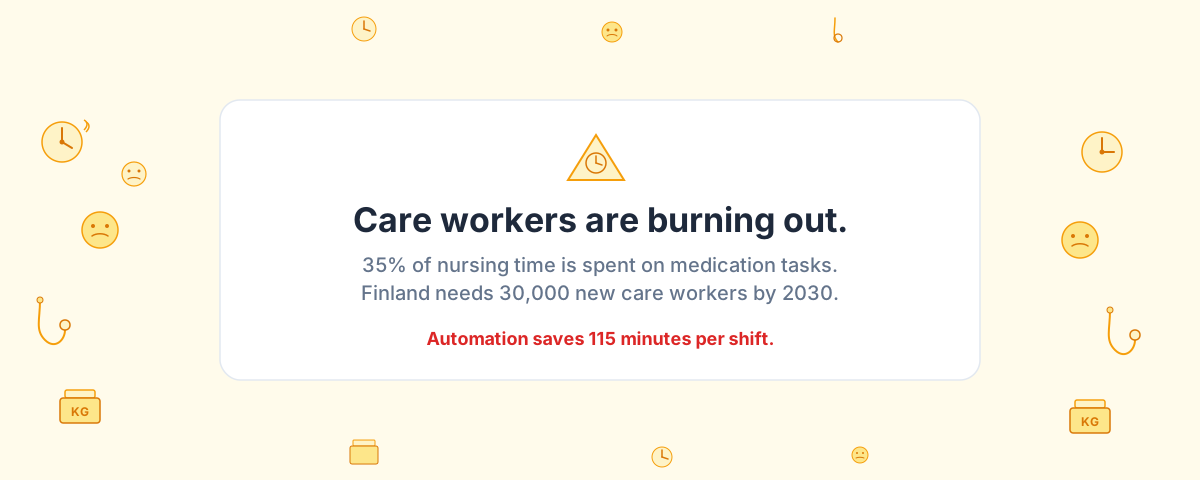
Nordic care workers spend up to 35% of their shift time on medication-related tasks. With Finland facing a 30,000 care worker shortage by 2030 and Swedish data showing 36% of medication errors caused by role overload, the current model is unsustainable. This report examines the workforce crisis and the evidence for automation.
In a nursing home in Helsinki, a care worker begins her morning shift at 7:00. By 7:15, she is sorting medications for 18 residents. Each resident takes an average of 9 medications. Some are tablets, some capsules, some liquids, some must be crushed. Some are given before breakfast, some with food, some after. She checks each medication against the prescription list, counts tablets, labels dose cups, and documents everything. By 8:30 — ninety minutes into her shift — she has not yet seen a single patient face to face.
This scenario plays out every day in care facilities across Finland and the Nordic countries. Research published in the *International Journal of Nursing Studies* (2019) confirms that care workers spend up to 35% of their total working time on medication-related tasks — preparation, administration, documentation, and verification. In a sector already crushed by staff shortages and burnout, this allocation of human time is not just inefficient. It is breaking the workforce.
And when exhausted workers manage medications under time pressure, patients pay the price. Swedish malpractice data reveals that 36% of medication errors were attributed to "role overload" as a contributing system factor (BMC Health Services Research, 2016). The errors are not caused by incompetent staff. They are caused by a system that asks too much of too few people.
The Medication Time Trap
To understand why medication tasks consume so much care worker time, it helps to break down what "medication management" actually involves in a typical care facility:
Preparation phase (40–60 minutes per medication round):
Retrieving medications from locked storage
Verifying each patient's current prescription against the medication list
Counting and sorting tablets and capsules into individual dose cups
Crushing tablets that need to be crushed, measuring liquid medications
Checking for drug interactions and allergies
Labeling each dose set with patient name and time
Administration phase (30–45 minutes per round):
Delivering medications to each patient individually
Confirming patient identity before administration
Observing patients taking their medications (particularly important for patients with swallowing difficulties or cognitive impairment)
Handling refusals, questions, and side effect reports
Administering medications via alternative routes where needed (eye drops, inhalers, patches, injections)
Documentation phase (15–25 minutes per round):
Recording each medication administration in the patient record
Noting any refusals, adverse reactions, or deviations from the prescribed schedule
Updating medication change orders received during the shift
Communicating medication issues to the next shift and to prescribing physicians
For a typical ward of 20 patients on 7 or more medications each, this cycle repeats 3–4 times per shift — morning, midday, afternoon, and evening medication rounds. The total: up to 3 hours per shift consumed by medication tasks alone for a single nurse.
Multiply this across an entire facility, across a full staffing roster, across the thousands of care facilities in Finland and the Nordics, and the scale of the medication time trap becomes clear. This is time not spent on patient interaction, clinical assessment, wound care, rehabilitation support, or simply being present for residents who need human connection.
The Nordic Staff Crisis
The medication time burden falls on a workforce that is already stretched beyond its limits. The staff shortage in Nordic elderly care is not a future projection — it is a present crisis that is worsening.
Finland faces a shortage of approximately 30,000 care workers by 2030, according to the Ministry of Social Affairs and Health. The Finnish government's nursing staff ratio requirement of 0.7 nurses per resident in 24-hour care has proven extremely difficult to meet, with many facilities reporting chronic understaffing. The Finnish Institute for Health and Welfare (THL) reports that turnover rates in elderly care exceed 20% annually — one in five care workers leaves their position each year.
Sweden faces the largest absolute shortage: the Swedish Association of Local Authorities and Regions (SKR) projects a need for 160,000 additional welfare sector workers by 2031. Care worker vacancy rates in Swedish municipalities have reached record levels, with some rural areas unable to fill more than 70% of positions.
Norway projects a shortage of 28,000 health and care workers by 2035 (Statistics Norway). The Norwegian government has launched multiple recruitment campaigns and increased training program capacity, but demand continues to outpace supply.
Denmark, despite smaller absolute numbers, faces proportionally similar challenges, with particular pressure in home care services where the shift from institutional care is most advanced.
Across the EU as a whole, the European Commission estimates a shortage of 4.1 million health workers by 2030 (State of Health in the EU, 2022). The care sector is competing for workers with every other industry — and losing, due to demanding working conditions, emotional toll, and wages that often do not reflect the complexity and responsibility of the role.
When Overwork Causes Errors
The link between care worker burnout and medication errors is not speculative — it is documented in research across multiple Nordic countries.
The most detailed evidence comes from a Swedish study analyzing 585 medication errors reported as malpractice cases involving nurses (BMC Health Services Research, 2016). The findings are striking:
68% of cases were attributed to "negligence, forgetfulness, or lack of attentiveness" — not to lack of knowledge or training, but to the cognitive effects of exhaustion and overwork
36% of cases identified "role overload" as a contributing system factor — nurses were responsible for too many patients, too many tasks, and too many competing demands
41% of errors involved administering the wrong dose — the type of error most associated with rushing and fatigue
17% of errors occurred during medication preparation — the phase most affected by interruptions and time pressure
Finnish data tells a consistent story. The national HaiPro incident reporting system records approximately 15,000 medication safety incidents annually, and analysis of reporting patterns shows that error reports peak during understaffed shifts and transition periods — precisely the times when workload pressure is highest (Frontiers in Pharmacology, 2020).
A European-wide study published in the *Journal of Advanced Nursing* (2019) found that nurses working 12-hour shifts had 28% more medication errors than those on 8-hour shifts, and that each additional patient added to a nurse's workload increased the probability of medication error by 6%.
The pattern is unambiguous: overworked care workers make more medication errors. Not because they are careless, but because the human capacity for sustained attention and accuracy is finite. When the system demands more than that capacity allows, errors are the inevitable result.
Automation: Giving Time Back to Caregivers
If medication tasks consume 35% of care worker time, and the care workforce is shrinking, then reducing the time spent on medication management is not a luxury — it is a mathematical necessity.
The evidence for automated dispensing as a time-saving intervention is substantial. A study published in the *Journal of Clinical Nursing* (2018) measured the impact of automated medication dispensing systems on nursing time allocation in elderly care facilities. The results:
Medication task time dropped by 64% — from an average of 180 minutes per shift to 65 minutes per shift
Time freed was redirected to direct patient care — face-to-face interaction time increased by 42%
Error rates decreased simultaneously — the time saving did not come at the cost of safety; both improved together
Staff satisfaction scores increased significantly — care workers reported feeling more professionally fulfilled when able to focus on clinical and interpersonal aspects of care
Additional evidence supports these findings:
A French geriatric unit study (Journal of Evaluation in Clinical Practice, 2014) found that automated unit-dose dispensing reduced the nursing time spent on medication preparation by over 50% while simultaneously reducing administration errors by 53%
Swedish facilities using automated multidose dispensing report that medication preparation time is virtually eliminated — nurses receive pre-sorted, labeled dose packets and spend their time on administration and patient interaction rather than counting and sorting (NCBI, 2014)
An ICU implementation study (NCBI, 2023) documented that automated dispensing cabinets reduced the time nurses spent retrieving and preparing medications by more than 40%
The key insight is that automation does not replace care workers. It replaces the mechanical, repetitive, error-prone tasks that prevent care workers from doing what they were trained to do — and what patients actually need: clinical judgment, empathetic communication, physical assessment, and human presence.
A nurse freed from 90 minutes of pill-sorting per shift gains 90 minutes for wound assessment, fall prevention, nutritional support, cognitive stimulation, and simply sitting with a resident who is lonely or frightened. This is not a marginal improvement. It is a fundamental redefinition of what care work can be.
The Path Forward
The Nordic care worker crisis will not be solved by recruitment alone. Even if every vacancy were filled tomorrow — which it will not be — the underlying model of manual medication management would remain unsustainable as patient volumes grow and regimens become more complex. The evidence points to a clear set of priorities:
Deploy automated dispensing in every care facility — make it the standard, not the exception. The 64% time saving documented in research translates directly to capacity equivalent to hiring thousands of additional staff
Redesign nursing workflows around automation — shift the care worker role from medication preparation to medication oversight, patient assessment, and care coordination
Invest in care worker retention — the burnout driving turnover is not inherent to care work; it is the result of systems that waste skilled human time on mechanical tasks
Measure and report medication task time — make this metric visible at the facility, regional, and national level so that progress can be tracked
Align Nordic policy with the evidence — Finland's staffing ratio requirements and the Nordic countries' care quality standards should explicitly recognize automated dispensing as a tool for meeting workforce and safety targets
Protect the profession — care work is skilled, meaningful, and essential. Automation should elevate it, not diminish it — by ensuring that care workers spend their time on tasks worthy of their training and humanity
Sources: International Journal of Nursing Studies 2019 (medication task time allocation); BMC Health Services Research 2016 (Swedish malpractice cases, 585 errors analyzed); Finnish Ministry of Social Affairs and Health (30,000 worker shortage projection); SKR Swedish Association of Local Authorities and Regions (160,000 shortage); Statistics Norway (Norwegian workforce projections); European Commission State of Health in the EU 2022 (4.1 million shortage); Frontiers in Pharmacology 2020 (Finnish HaiPro data); Journal of Clinical Nursing 2018 (automated dispensing time savings, 64% reduction); Journal of Evaluation in Clinical Practice 2014 (French geriatric unit); NCBI 2014 (Nordic automated MDD study); NCBI 2023 (ICU automated dispensing); Journal of Advanced Nursing 2019 (shift length and error rates); THL Finnish Institute for Health and Welfare (turnover and staffing data).