Aging Nordics: When 27.8% of Finland Is Over 65, Who Manages the Medications?
By 2030, 27.8% of Finland's population will be over 65 — the fastest-aging demographic in the EU. With 41% polypharmacy rates, an average of 9.1 medications per nursing home resident, and deepening care workforce shortages, the Nordics face a medication management crisis that manual processes cannot solve.
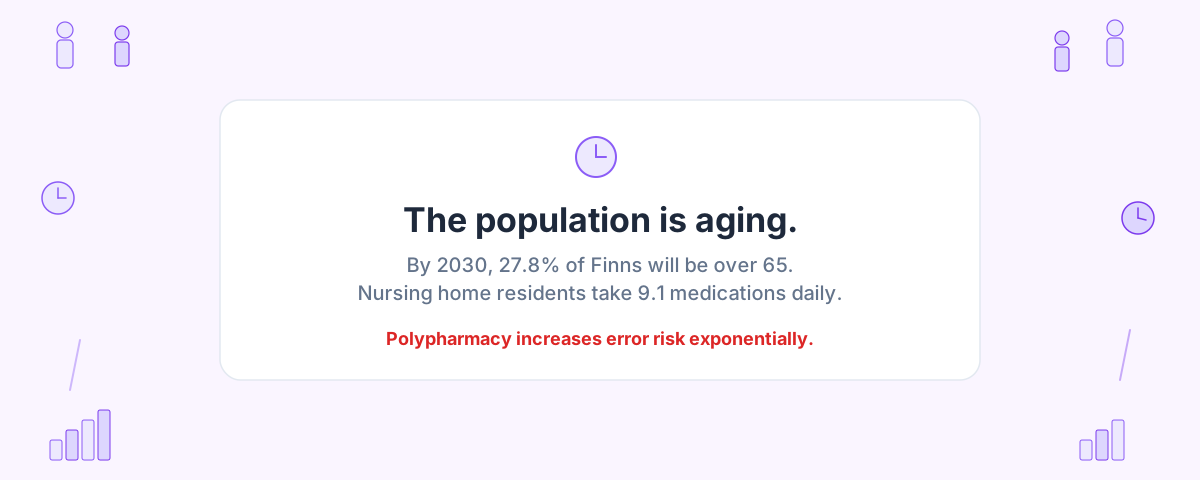
Finland is aging faster than almost any other country in Europe. By 2030, an estimated 27.8% of the Finnish population will be aged 65 or older (Statistics Finland, Eurostat projections). This is not a distant demographic trend — it is a transformation already underway, and its impact on medication management is profound.
Today, Finland's elderly population already drives the majority of medication consumption, the majority of medication errors, and the majority of care workforce demand. When one in four citizens requires complex, multi-drug medication regimens managed by a shrinking care workforce, the question is no longer whether the system will be strained — but whether it can cope at all.
The Nordic Aging Wave
Finland is not alone — but it is leading the wave. Across the Nordic countries, the demographic shift is reshaping healthcare demand:
Finland: Projected 27.8% aged 65+ by 2030 (Statistics Finland). Already the fastest-aging country in the EU, with the old-age dependency ratio rising from 33.5% in 2020 to a projected 42.8% by 2035. Over 49,500 patients were receiving automated dose dispensing through community pharmacies as of 2016, a figure that has continued to grow (Fimea)
Sweden: Approximately 20.3% of the population is currently aged 65+, with 180,000 individuals receiving medicines via automated multidose dispensing (MDD). About 80% of MDD recipients are aged 65 years or older (NCBI, 2014). Sweden's National Board of Health and Welfare projects that the number of people aged 80+ will increase by 50% between 2020 and 2035
Norway: The share of population aged 67+ is projected to grow from 16% to 22% by 2040 (Statistics Norway). Research shows that 27% of elderly patients already use at least one potentially inappropriate medication (NCBI, 2009), a figure likely to worsen as the elderly population expands
Denmark: Currently at 20.1% aged 65+, with particular challenges at care transitions. A study of 758 patient transfers found 142 medication errors — an average of 2 errors per patient transfer between primary and secondary care
The combined Nordic elderly population is projected to grow by over 1.5 million people by 2040, while the working-age population in most Nordic countries is projected to shrink or remain flat.
The Polypharmacy Multiplication Effect
Aging does not just increase the number of patients — it multiplies the complexity of each patient's medication regimen. Finland holds a concerning European record: the highest polypharmacy rate (41%) among 8 European countries studied in the ADHOC project (Aged in Home Care) for elderly home care patients taking 9 or more medications.
In Finnish nursing homes, the picture is even more stark. Studies report an average of 9.1 medications per resident, with some patients on 15 or more concurrent drugs. Each additional medication adds:
New dosing schedules — increasing the number of daily administration events that must be correctly timed
Drug interaction risks — the probability of a clinically significant interaction rises exponentially with the number of concurrent medications
Error opportunities — every pill that must be selected, counted, and administered is a potential point of failure
Across European nursing homes in the SHELTER study, 49.7% of residents had polypharmacy (5+ medications) and 24.3% had excessive polypharmacy (10+ medications). Finland consistently ranks at or near the top of these measures.
The clinical consequences are documented. The BMC Medicine 2020 meta-analysis of 81 studies and 285,687 patients found the highest prevalence of preventable medication harm (11%) in elderly care units — more than double the rate in surgical care or emergency departments. Polypharmacy is the primary driver.
Care Workforce Under Pressure
The demographic equation has two sides: more elderly patients requiring complex medication management, and fewer care workers available to provide it. Across the Nordic countries, workforce shortages in elderly care are already acute and projected to worsen dramatically.
In Finland, the Ministry of Social Affairs and Health has acknowledged a structural shortage of nurses and practical nurses in elderly care. The new staffing ratio requirement of 0.7 care workers per resident in 24-hour care, introduced to improve quality, has paradoxically highlighted the gap — many facilities struggle to meet even this minimum. The Finnish Institute for Health and Welfare (THL) projects that Finland will need 30,000 additional care workers by 2030 just to maintain current service levels.
Sweden's situation is equally strained. An analysis of 585 medication errors reported as malpractice cases found that 36% cited "role overload" as a contributing system factor (BMC Health Services Research, 2016). When care staff are responsible for more patients with more medications and less time per patient, medication errors are not a matter of individual failure — they are a system outcome.
In Norway, the government has launched multiple recruitment campaigns for geriatric care, but Statistics Norway projects a shortfall of 28,000 health and care workers by 2035. Denmark faces similar constraints, with the Danish Health Authority projecting growing demand that outpaces training capacity.
The mathematics are unforgiving: more patients, more medications per patient, fewer staff per patient. Manual medication management processes — counting pills, preparing dose trays, checking paper records — do not scale. They break down exactly where they are needed most.
Home Care: The Growing Frontier
Across the Nordics, healthcare policy has shifted decisively toward home-based care. The logic is sound: most elderly patients prefer to live at home, and institutional care is expensive. Finland has been a leader in this shift — the number of home care clients has grown steadily, while institutional care places have been reduced.
But the shift to home care creates a medication safety gap that has not been adequately addressed. In institutional settings, medications are at least managed by trained staff (however overstretched). In home care, the responsibility often falls on:
The patients themselves — many of whom have cognitive decline, impaired vision, or limited dexterity that makes medication self-management unreliable
Family caregivers — who lack training in medication management and may be managing their own health challenges
Home care nurses — who visit for limited time windows and may see a patient only once or twice daily, leaving most medication administration events unsupervised
Finland's Fimea has documented that home care patients are significantly more likely to accumulate unused medications, experience adherence problems, and have medication lists that are not current. The ADHOC study's finding of 41% polypharmacy in Finnish home care patients underscores the challenge: these are not patients on simple regimens.
The Finnish national HaiPro incident reporting system captures medication errors in institutional settings — but home-based medication errors are largely invisible to the reporting infrastructure. The true scope of medication harm in home care is almost certainly underestimated.
Technology as the Missing Link
The Nordic aging challenge cannot be solved by hiring alone — the workforce simply is not available. And it cannot be solved by accepting current error rates — the human cost is too high. Technology, specifically automated medication dispensing, addresses both sides of the equation simultaneously.
The evidence from Nordic and international studies is consistent:
Automated dispensing cabinets reduce dispensing errors by 75–80% (Swiss Hospital Study; Taiwan ADC implementation)
Unit-dose dispensing in a French geriatric unit achieved a 53% reduction in medication administration errors (Journal of Evaluation in Clinical Practice, 2014)
Full traceability systems — electronic prescription, automated preparation, barcode administration — achieve an overall 58% reduction in medication errors (ECAMET White Paper, 2022)
ICU implementation reduced dispensing errors from 3.87 per 100,000 to zero per 100,000 dispensations (NCBI, 2023)
For the aging Nordics, automated dispensing is not a luxury — it is infrastructure. Just as the Nordics invested in digital health records, e-prescriptions, and national health registries, the next infrastructure investment must be in the physical delivery of medications: automated, traceable, and safe.
Looking ahead, the projections demand action now:
By 2030, Finland will have approximately 1.6 million residents aged 65+, each averaging over 6 prescribed medications
By 2035, the Nordic elderly care workforce gap will exceed 100,000 workers across Finland, Sweden, Norway, and Denmark combined
Polypharmacy rates will continue to climb as medical treatments become more specialized and life expectancy increases
Home care will become the dominant care setting for elderly patients, requiring medication management solutions that work outside institutional walls
Without systemic change, medication errors in elderly care will increase proportionally with the patient population — adding thousands of preventable harm events annually
The Nordics have built some of the world's best healthcare systems. The question now is whether those systems can adapt fast enough for the demographic reality that is already here.
Sources: Statistics Finland population projections; Eurostat demographic data; Fimea (Finnish Medicines Agency); NCBI 2014 (Nordic automated MDD study); NCBI 2009 (Norwegian elderly medication use); ADHOC Project (European home care polypharmacy); SHELTER Study (European nursing home polypharmacy); BMC Medicine 2020 (preventable harm meta-analysis); BMC Health Services Research 2016 (Swedish malpractice cases); Statistics Norway population projections; Swedish National Board of Health and Welfare; Danish Health Authority workforce projections; THL (Finnish Institute for Health and Welfare); Journal of Evaluation in Clinical Practice 2014; ECAMET White Paper 2022; NCBI 2023 (ICU automated dispensing); Ministry of Social Affairs and Health Finland.